
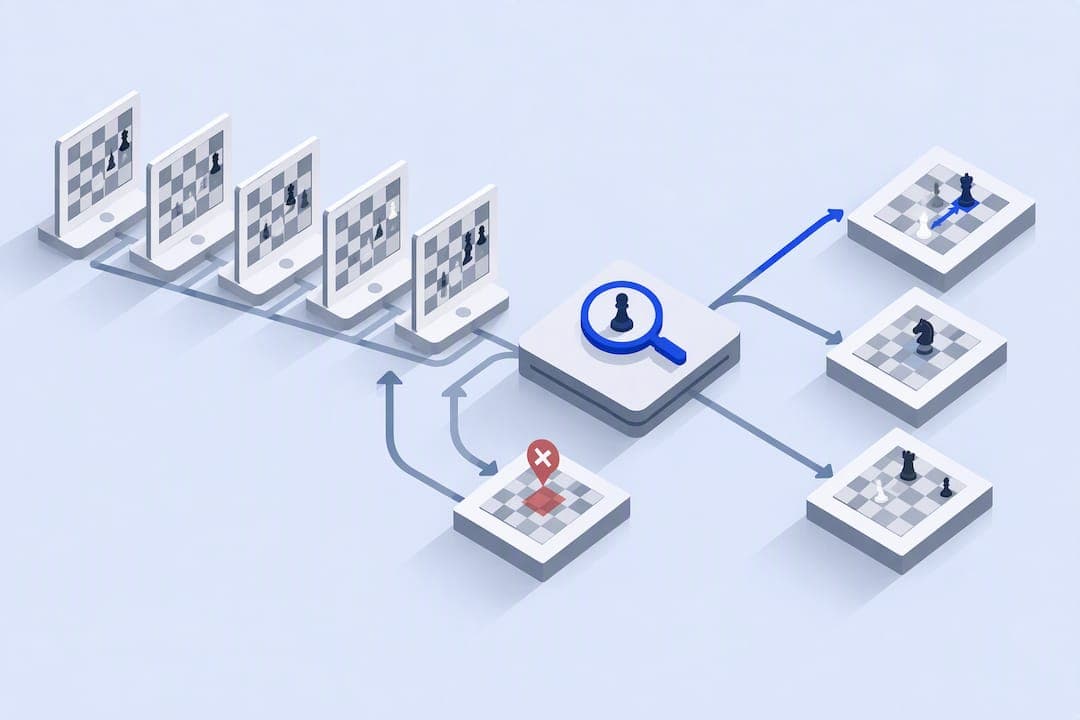
The biggest recurring chess mistakes almost always fall into six buckets: missed tactics, weak development, king safety lapses, planless middlegames, time trouble, and shallow post-game review. Pull your last five games right now and mark the first move where the evaluation swung hard against you. That single moment, repeated across games, is your dominant pattern. Fix that one thing before you touch anything else.
TL;DR:
- Most recurring chess mistakes stem from missed tactics, poor development, and king safety lapses, which should be addressed one category at a time.
- Identifying your main swing move pattern across recent games reveals whether tactical errors, timing issues, or positional mistakes cost you the most points.
- Focused drills tailored to your diagnosis, such as tactics puzzles or endgame practice, produce better improvements than spreading effort across all mistakes.
- Analyzing your swing moves with dedicated tools accelerates pattern recognition and helps confirm the most impactful error category.
- Understanding common opening traps and emotional influences like overconfidence or tilt prevents repeating the same pitfalls, especially under time pressure.
Table of Contents
- The 10 Recurring Chess Mistakes Costing You Games
- Why You Keep Repeating the Same Chess Mistakes
- A 4-Step Routine to Diagnose Your Recurring Mistake
- Targeted Drills That Actually Fix Recurring Chess Mistakes
- How Analysis Platforms Speed Up Fixing Recurring Mistakes
- Opening Traps: Why You Keep Falling for the Same Tricks
- Overconfidence, Fear, and the Psychology of Repeating Mistakes
- Why Pattern Recognition Stops Errors From Repeating
- Endgame Mistakes: The Quiet Repeat Offenders
- Author Perspective: Stick to One Fix and Measure It
- Try Nexa Chess to Stop Repeating the Same Mistakes
- Sources
- FAQ
The 10 Recurring Chess Mistakes Costing You Games
You don't need to overhaul your whole game. You need to find the two or three errors showing up over and over and kill them one at a time. Here's the full lineup, ranked roughly by how often they show up in club-level games.
- Missing tactics and blunders. You calculate the plan but skip the checking move. Fix: before every move, ask "does this hang anything or allow a check, capture, or threat?"
- Neglecting piece development. Knights and bishops sit home while you chase a side idea. Fix: aim to develop your minor pieces steadily during the opening phase.
- Exposing the king. You delay castling or open lines near your own king. Fix: treat king safety as a checklist item every move, not an afterthought.
- Moving the same piece repeatedly in the opening. Shuffling one knight back and forth burns tempo. Fix: if a piece has already moved once, ask why it needs to move again before development finishes.
- Playing without a plan. Moves look reasonable in isolation but don't build toward anything. Fix: after the opening, state your plan in one sentence before moving.
- Premature attacks. You launch a pawn storm before your pieces are ready to support it. Fix: count attackers versus defenders before committing.
- Poor endgame technique. Basic king-and-pawn or rook endgames get botched from unfamiliarity. Fix: drill 20 minutes of endgame theory weekly, not just openings.
- Time trouble and rushed moves. You spend too long early and panic later. Fix: set a per-move budget and track it with a simple clock split.
- Emotional carryover, or tilt. One blunder triggers reckless moves for the rest of the game. Fix: pause 15 seconds after any mistake before your next move.
- Shallow post-game analysis. You run the engine, glance at the arrows, and move on. Fix: write one sentence explaining why each flagged move failed, in your own words.
Why You Keep Repeating the Same Chess Mistakes
Most recurring errors survive because the training doesn't match the actual gap. The FIDE EDU Archive points out that rating plateaus usually come from misconceptions and from practicing outside your Zone of Proximal Development, meaning you're drilling material either too easy to matter or too hard to absorb.
Time pressure makes it worse in a measurable way. A Scientific Reports study analyzing nearly 40,000 positions from elite blitz games found that blunder probability doesn't rise smoothly as time runs out. It spikes. Confusion and a ticking clock compound each other.
The third culprit is how you review. Chess notes that passive engine reading, just glancing at the best-move arrow, doesn't fix anything. The error gets logged in the game but never in your head.
A 4-Step Routine to Diagnose Your Recurring Mistake
Run this after every 5 to 10 games, using the same time control so the comparison is fair.
- Step 1: Pull 5 to 10 recent games from one time control (rapid, blitz, or classical, not mixed).
- Step 2: Find the earliest move in each game where the evaluation swings hard, then label it: tactical, strategic, time-related, or psychological.
- Step 3: Tally the labels. Whichever category appears most, and costs the most points, is your priority.
- Step 4: Assign exactly one drill to that category for your next three training sessions.
- Track the swing move's move number, not just the category, so you can spot whether errors cluster early or late in the game.
- Note your remaining clock time at the swing move. If it's consistently low, time management is your real issue, not the tactic you missed.
This mirrors the diagnostic approach described by ChessWorld's training guidance, which found that classifying the first major swing across recent losses surfaces the dominant pattern faster than general study.
Targeted Drills That Actually Fix Recurring Chess Mistakes
Pick the one category your diagnosis flagged and drill it specifically. Spreading effort across all ten mistakes at once is how plateaus form in the first place.
- Blunder drill. Ten minutes of tactics puzzles as a warm-up, then a mandatory three-step blunder check (checks, captures, threats) before every move in your next 5 games.
- Development drill. Play five games with a rule: no queen moves before move 8, and count your developed minor pieces out loud at move 10.
- King safety drill. Add a 10-second safety scan before each move, then play three games focused purely on castling timing.
- Time management drill. Set a clock budget per phase (opening, middlegame, endgame) and enforce it across ten 10+5 rapid games.
- Analysis drill. After each engine review, write down what you considered, which candidate moves you rejected, and why, before looking at the engine's preferred line.
The FIDE EDU Archive recommends this play-then-analyze loop specifically: play several rapid games with moderate time controls, then review them together, so patterns across games become visible instead of buried in single-game noise.
Pro Tip: Choose drills that sit just above your current level, not generic advice like "always look for three candidate moves." Practicing inside your Zone of Proximal Development is what actually moves the needle; drilling too far below or above it just wastes the session.
How Analysis Platforms Speed Up Fixing Recurring Mistakes
Manually tagging swing moves across ten games works, but it's slow. A consolidated analysis tool speeds up the same diagnostic loop the routine above describes.
- Import PGNs from Lichess and Chess.com into one place instead of reviewing each platform separately.
- Check the phase breakdown (opening, middlegame, endgame) to see where your evaluation swings actually cluster.
- Look at the recurring-error report to confirm whether your suspected pattern (say, king safety) is really your top category or just the most memorable one.
- Once the platform flags a dominant category, map it directly to one of the drills above for the coming week instead of guessing.
Some analysis platforms consolidate games from both platforms, run Stockfish-based evaluation across all three phases, highlight recurring mistakes automatically, and may be free to use.
Opening Traps: Why You Keep Falling for the Same Tricks
Opening traps work because they exploit a natural move, not a bad one. The Fried Liver Attack, the Legal's Mate pattern, and the Elephant Trap in the Queen's Gambit all bait a reasonable-looking capture or development move that quietly loses material two or three moves later.
Players fall into the same trap repeatedly for one simple reason: they memorize the refutation for one specific trap but never learn the underlying principle. You dodge the Fried Liver once because a coach showed you the line, then walk straight into a nearly identical knight sacrifice in a different opening six months later, because you never learned that the pattern is "don't grab a poisoned pawn with your king undeveloped."
The fix isn't memorizing more traps. It's asking one question every time an opponent offers you a free pawn or piece in the first ten moves: what do they get if I take it? If you can't answer that in under 15 seconds, don't take it yet. Review your losses specifically for opening traps using the same swing-move method from your diagnostic routine. If two or three losses share the same trap shape, even in different openings, that's a pattern worth drilling on its own, separate from your general opening prep.
Overconfidence, Fear, and the Psychology of Repeating Mistakes
Two emotional states drive more recurring errors than most players realize. Overconfidence shows up after a strong opening or a won piece. You stop calculating carefully because the position "feels" won, and that's exactly when a tactical shot lands. Fear works in the opposite direction. After a blunder or a scare, players tighten up, avoid sharp lines they'd normally play, and make passive moves that hand the initiative back to the opponent.
Both states produce the same practical symptom: you stop checking candidate moves as rigorously as you did five moves earlier. Confidence tells you the check is unnecessary. Fear tells you any active move is too risky. Neither is really about the position on the board.
Tilt is the sharpest version of this. One blunder early in a game often triggers a cascade of worse decisions for the rest of that game, and sometimes the next several games in a session. The fix isn't complicated but it is hard to actually do: pause for 15 seconds after any mistake you notice mid-game, name the emotion (frustration, panic, overconfidence), and then evaluate the position fresh, as if you just sat down. Players who track their emotional state alongside their move quality tend to notice that a large share of their "random" blunders cluster right after a previous mistake, not randomly across the game.
Why Pattern Recognition Stops Errors From Repeating
Pattern recognition is the difference between fixing a mistake once and fixing it every week. If you solve a tactics puzzle and get it right, you've handled one position. If you notice that the puzzle depended on a pinned knight failing to guard a back-rank square, and you file that shape away, you've handled a category of positions you haven't seen yet.
Most recurring mistakes aren't really about one bad move. They're about failing to recognize a shape you've already encountered, just dressed differently. A player who keeps losing material to discovered attacks usually isn't unaware discovered attacks exist. They just haven't built the visual reflex to spot the setup before it fires.

This is why generic tactics training plateaus for a lot of intermediate players. Solving 500 random puzzles teaches breadth, but it doesn't necessarily fix your specific recurring gap unless a meaningful chunk of those puzzles happen to hit your weak pattern. Targeted pattern drills, ones built from your own recurring error category, transfer better because you're rehearsing the exact shape that keeps beating you, in the same kind of position you actually reach.
Endgame Mistakes: The Quiet Repeat Offenders
Endgame errors recur more stubbornly than opening or middlegame mistakes for one reason: players study openings constantly and endgames rarely. A rook endgame mistake you make this month is often the identical mistake you made a year ago, because nothing in between corrected it.
The common recurring endgame errors follow a short, predictable list: wrong-side king positioning in king-and-pawn endgames, mishandling opposition, misplaying the Lucena or Philidor rook endgame positions, and rushing pawn promotion without checking for stalemate tricks. None of these require deep calculation. They require knowing the technique cold, the way you know how to castle.

Because endgame positions are simpler than middlegame ones, the errors are also easier to isolate. If your diagnostic routine flags "endgame" as a swing category, you can usually trace the exact type (king activity, opposition, or a specific theoretical position) within one or two games. Twenty minutes a week on core endgame technique, separate from puzzle solving, tends to close this gap faster than almost any other category of recurring mistake, simply because the material is finite and well documented.
Author Perspective: Stick to One Fix and Measure It
Plateaus are frustrating, and they're normal. Pick one recurring mistake, work it for several weeks, and track it with the same diagnostic routine after every block. Progress on one thing beats scattered effort on ten.
— carles
Try Nexa Chess to Stop Repeating the Same Mistakes
There are platforms designed to consolidate games from both Lichess and Chess.com into one dashboard, then run Stockfish evaluation across openings, middlegames, and endgames to highlight actual recurring mistakes, not just remembered ones.

Instead of manually tagging swing moves across ten games by hand, import 5 to 10 of your recent games and run the recurring-mistake report. It'll show you the same thing your diagnostic routine is designed to find, just faster: which category (tactical, developmental, king safety, time trouble) is actually costing you the most points right now. The platform is free to use, with no credit card required. Start by importing your most recent losses at Nexa Chess and see which pattern surfaces first.
Sources
For deeper reading on the research behind this article: the Scientific Reports study on time pressure and error amplification covers the blitz blunder data in full, the FIDE EDU Archive on plateaus explains the Zone of Proximal Development concept, and Chess.com's piece on recurring mistakes breaks down why passive review fails to fix errors.
- Interpretable machine learning analysis of nonlinear error amplification under time pressure and positional ambiguity in elite blitz chess | Scientific Reports
- Chess
FAQ
Why Do I Keep Making the Same Mistakes in Chess?
Recurring mistakes usually survive because training doesn't target the actual gap. The FIDE EDU Archive notes that plateaus often come from misconceptions or practicing outside your Zone of Proximal Development, and passive engine review without active reconstruction lets the same errors slip through unnoticed.
Is 97% Accuracy Cheating in Chess?
No single accuracy number proves cheating on its own; anti-cheat systems weigh accuracy alongside move-timing patterns, rating context, and game length rather than a flat threshold. A very high accuracy score in one game can simply reflect a clean, forced sequence, so platforms look at consistency across many games, not one outlier result.
What Is the 40-40-20 Rule in Chess?
This typically refers to a time-control format: 40 moves in the first period, followed by additional time controls, often used in classical over-the-board tournaments to structure long games. It's a scheduling convention rather than a strategic principle, and it varies by tournament organizer.
What Is Considered the Strangest Rule in Chess?
Many players point to the "en passant" pawn capture or the touch-move rule as the most surprising rules for newcomers, since neither behaves like any other move in the game. Threefold repetition and specific drawn-game rules also confuse beginners because they can end a game with no capture or check at all.
How Do I Identify My Own Recurring Mistakes?
Pull 5 to 10 recent games from the same time control, find the earliest move in each where the evaluation swings hard, and label the error type. Whichever category shows up most often, tactical, developmental, king safety, or time-related, is your priority to drill next, and a tool like Nexa Chess can automate that tagging across your imported games.