
Use move-by-move stats from your own games plus engine checks to find the small number of opening lines you should fix or replace. Import your Lichess or Chess.com history, sort your openings by frequency and score, then run Stockfish on the branches where you bleed points. That combination usually surfaces one weak line worth dropping and one model game worth memorizing within an hour of work.
TL;DR:
- Analyzing your openings with move-by-move stats, engine checks, and model games helps identify a few weak lines to drop or memorize, saving time.
- Focus on high-frequency, low-scoring lines and moves with high average centipawn loss, as these indicate plans you don't understand or tactical gaps.
- Build a short study list targeting three problem lines, using repetitions and tactical drills to reinforce correct plans and avoid overhauling your entire repertoire.
- Use tools like Nexa Chess to import, analyze, and track your progress, ensuring study efforts translate into measurable improvement.
- Recognize common opening traps by pattern identification and tailor your preparation to exploit opponent tendencies and avoid falling into familiar tactical motifs.
Table of Contents
- What Does Opening Analysis in Chess Actually Show You?
- How Do You Analyze Your Own Chess Openings Step by Step?
- Which Opening Metrics Actually Matter?
- Turning Stats Into Study: Model Games and Drills
- How Nexa Chess Applies This Workflow
- What Are the Most Common Opening Traps to Watch For?
- How Do You Prepare Against a Specific Opponent's Openings?
- Making Sense of Opening Trees and Move Probability Tools
- Reading Engine Evaluations Without Getting Fooled
- The Difference Between Knowing Theory and Understanding Your Own Games
- Try Nexa Chess: Import, Analyze, Study
- Sources
- FAQ
What Does Opening Analysis in Chess Actually Show You?
Opening explorers are not just move lists. The good ones layer three kinds of data on top of each other, and understanding what each layer tells you is the difference between staring at numbers and actually fixing something.
Move-by-move win, draw, and loss percentages tell you what happens after each choice, weighted by how often the position occurs. Model games attached to a line show how strong players actually handled the resulting middlegame, which matters more than the seventh move of a memorized line. ECO grouping and filters by rating band or time control keep the sample honest. A repertoire choice that scores well among 2400s in classical games can perform very differently in your 5-minute bullet pool.
- Win/draw/loss by move, weighted by popularity, not just raw score
- Model games grouped by ECO code with filters for rating and time control
- Engine evaluations and centipawn loss per move, showing where a plan quietly went wrong
The New Opening Encyclopaedia 2026 leans hard on this structured approach. It ships more than 1,500 theory databases, 40,000 model games, and 8,200 opening surveys, built specifically to move players away from memorizing raw lines and toward understanding typical plans.
How Do You Analyze Your Own Chess Openings Step by Step?
Here is the actual sequence, in order, using nothing but your own game history and free tools.
- Import and filter your games. Pull your PGN from Lichess or Chess.com, then filter by time control and the rating range you actually play at now, not two years ago.
- Build an opening tree sorted by frequency and score. Every opening explorer worth using will let you sort by how often a line comes up and how you score in it. Frequency first, score second.
- Flag the weak spots. Any line played often with a below-50% score, or with high average centipawn loss, gets a red flag. Pull a representative game where it went wrong.
- Run engine checks on the critical branch points. Don't check every move. Check the moment the game left known theory or where your score collapsed, and note what the engine considers the right plan, not just the right move.
- Build a 4 to 6 item study list. Turn the flagged lines into concrete tasks: "review the Najdorf 6.Bg5 line," not "get better at Sicilian." Schedule short 15 to 20 minute drills, not marathon sessions.
Pro Tip: Don't fix more than two openings at once. Trying to overhaul your entire repertoire in a week guarantees you'll retain none of it. Pick your worst-scoring line as White and your worst as Black, master those, then move to the next pair.
GM Jon Speelman's work on engine-assisted preparation is a useful reminder here: centaur analysis can surface a genuinely strong novelty, but it still has to survive contact with a normal middlegame plan. An engine move that scores +0.6 but requires four only-moves to justify is not a repertoire choice, it's a trap for you.
Which Opening Metrics Actually Matter?
Most players track too many numbers and act on none of them. Three metrics do almost all the useful work.
- Frequency times score. A line you play in 30% of your games and score 42% in outranks a line you play in 3% of games and score 35% in. Fix the common leak before the rare one.
- Centipawn loss versus outright blunders. Steady centipawn loss of 20 to 30 per move across an opening usually signals a plan you don't understand. A single blunder of 150+ centipawns on one move usually signals a tactical gap, not a repertoire problem.
- Sample size and rating filters. Ten games is not a trend. Filter to your current rating band and a reasonable time control before drawing conclusions from any line.
By the numbers: The Opening Encyclopaedia's database spans 8,200 opening surveys and 40,000 annotated model games, which is the scale of material behind the "typical plan" judgments serious opening study now relies on instead of raw move memorization.
Below 1600, weight blunders heavier than centipawn drift. Above 2000, the reverse is usually true. Stockfish is the engine behind most of these centipawn calculations, and its evaluations are only as useful as the sample size feeding them.
Turning Stats Into Study: Model Games and Drills
Numbers tell you where the problem is. They don't fix it. That takes deliberate rehearsal built around real games.
- Pick three model games per problem line. One shows the opening move order cleanly, one shows the typical middlegame plan (pawn breaks, piece rerouting, the target square), one shows how the resulting structure tends to resolve into an endgame.
- Build short, specific drills. Repeat the move order from memory until it's automatic. Solve two or three tactical motifs that recur in that structure. Run a five-minute engine check on the position where you usually go wrong.
- Check weekly trends, not daily ones. Track score by line, average centipawn loss, and error type week over week. Opening fixes take real games to confirm, not one session.
Pro Tip: Annotate your own model games in one sentence each: "White wins the c5 square, trades light-squared bishops, pushes b4." That single sentence is more useful in a pre-game refresher than the full game score.
How Nexa Chess Applies This Workflow
Nexa Chess was built around exactly this loop: import, sort, flag, fix. It pulls games directly from Lichess and Chess.com and consolidates them into one dashboard, so you're not toggling between two platforms to see your full opening picture.
- Phase-based Stockfish analytics break down accuracy separately for opening, middlegame, and endgame, so a weak opening score doesn't get masked by a strong middlegame recovery
- A virtual FIDE rating estimate gives you a benchmark for how your online results translate to over-the-board strength
- Weekly trend views and ECO-code breakdowns show whether last week's study actually moved the needle on a specific line
That last point matters more than it sounds. Most players never check whether a study session changed anything measurable, and Nexa Chess's performance tracking is built specifically to close that loop.
What Are the Most Common Opening Traps to Watch For?
Traps and tactical motifs cluster around a handful of recurring ideas, and recognizing the pattern matters more than memorizing the specific trap.
The Legal's Mate pattern, the Fried Liver Attack, and the various early queen sorties in the Scandinavian all share a structure: they exploit a piece that hasn't developed, a king that hasn't castled, or a pawn move that opened a diagonal one tempo too early. Once you see the underlying pattern (undefended f7/f2, a pinned knight, a queen that can be attacked with tempo) you start recognizing the trap family across dozens of openings instead of memorizing each one individually.
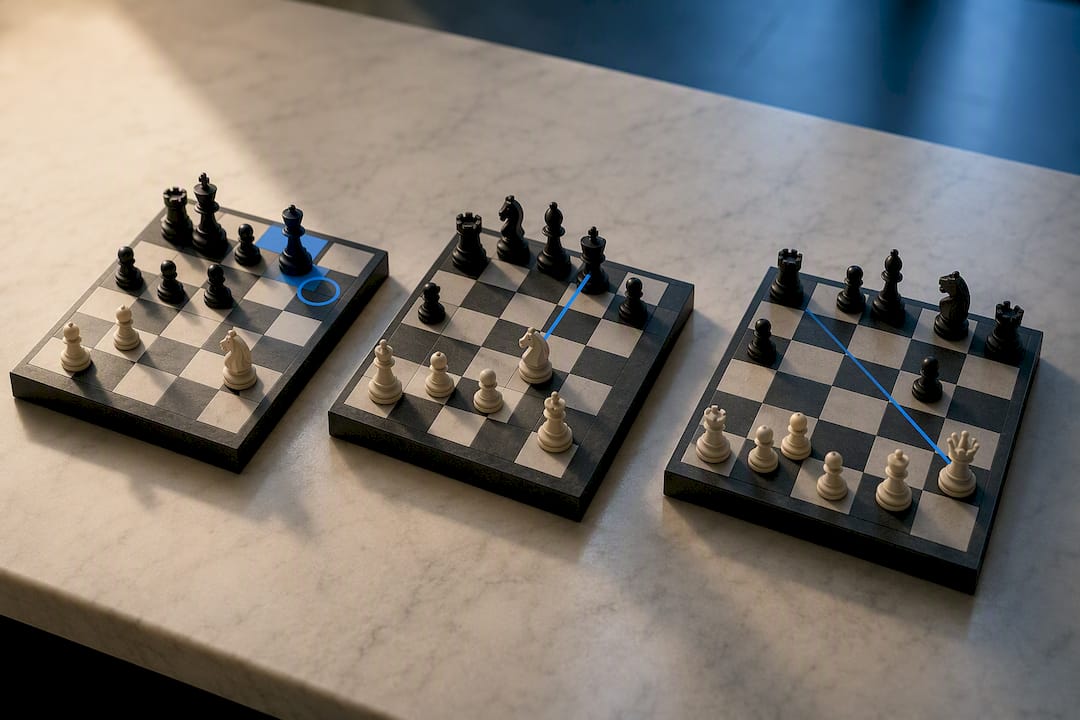
Your own games are a better trap-detection tool than a puzzle book, because they show you which specific tactical motifs you actually fall for. If your engine checks keep flagging the same kind of tactical miss (say, a knight fork on c7 or a back-rank issue after trading rooks), that's a pattern worth drilling directly rather than hoping general tactics training covers it.
The flip side matters too: know which traps exist in your own repertoire so you can spring them. A line that scores well specifically because opponents fall for a common mistake is worth keeping, even if the "objective" engine evaluation is only slightly better than equal. Practical results and engine truth are not the same thing, and opening prep lives in the gap between them.
How Do You Prepare Against a Specific Opponent's Openings?
Scouting an opponent's opening habits is one of the highest-leverage things you can do before a tournament game, and it takes less time than most players assume.
Pull your opponent's recent games from Lichess or Chess.com and build the same kind of opening tree you built for yourself, filtered by their color and, if you can find it, their preferred time control. Look for repetition. Most players, even strong ones, have two or three go-to systems they return to constantly because switching repertoires is exhausting. If you find your opponent has played the same sideline in the London System nine times in the last twenty games, that's not a coincidence, that's a target.
Cross-reference their score in that line against the field average. If they're overperforming, figure out why before you walk into it blind. Sometimes it's genuine understanding of the resulting middlegame, and sometimes it's just that most opponents don't know the correct response and you'll be the exception who does.
Pay attention to time control differences too. A player's blitz repertoire and classical repertoire often diverge sharply, since sharper, more theoretical lines carry more risk under time pressure. Preparing the wrong version of their repertoire because you scouted the wrong time control is a common and avoidable mistake.
Making Sense of Opening Trees and Move Probability Tools
Visual opening trees turn a wall of notation into something you can actually navigate, and most modern platforms build them the same basic way: each branch width represents how often a move gets played, and color coding represents score.
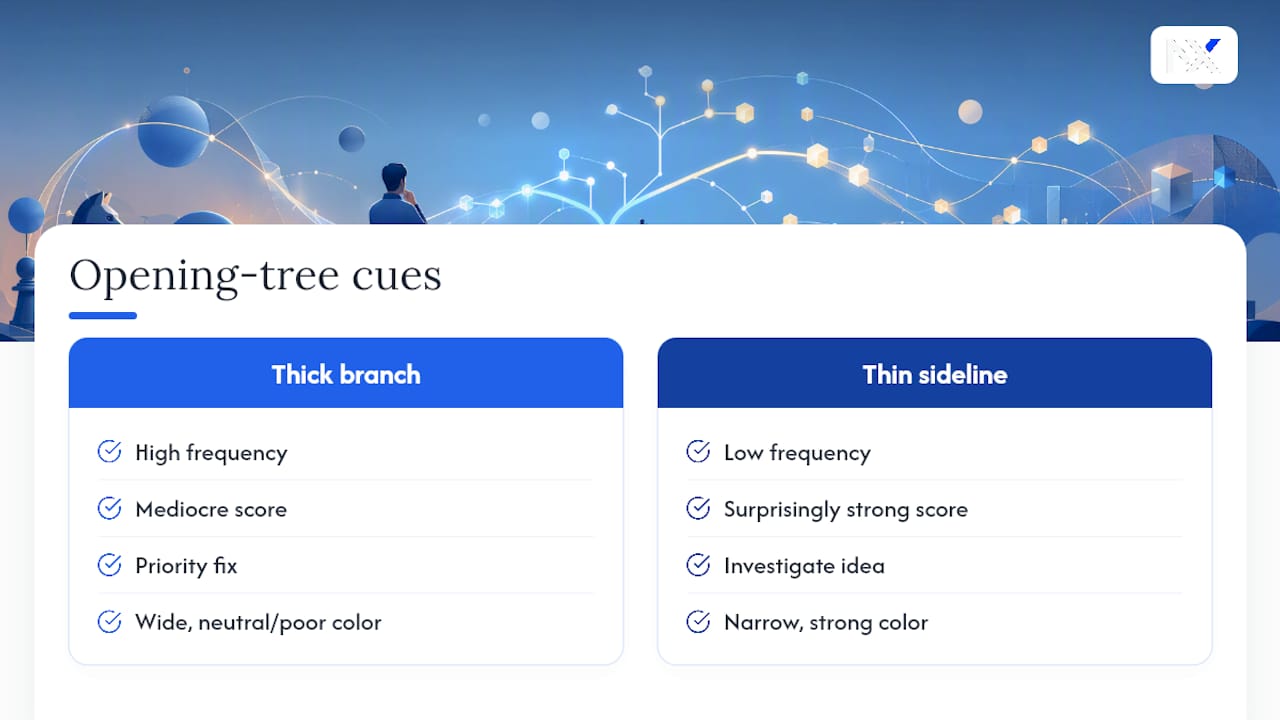
The value of this view is spotting outliers fast. A thin branch with a surprisingly strong score is worth investigating, since it might be an underused idea nobody has figured out how to punish yet. A thick branch with a mediocre score is your priority fix, since it means you keep walking into the same suboptimal position.
Move probability data also helps with practical decision-making at the board. Tree visualization makes that tradeoff visible in a way a flat list of variations never does.
Reading Engine Evaluations Without Getting Fooled
A plus-one-point engine evaluation and an actual winning position are not the same thing, and treating them as identical is one of the most common mistakes in opening study.
Stockfish and similar engines assign a numeric score to a position, but that score doesn't capture how hard the position is to play for a human. A position evaluated at +0.8 that requires finding the only good move for the next six turns is, in practical terms, worse for you than a +0.3 position with several reasonable tries. This is exactly the tension Jon Speelman raises in his writing on engine-assisted preparation: a centaur-discovered novelty can look objectively strong while being nearly unplayable over the board without extensive memorization.
Look past the raw number at three things: king safety, piece activity, and pawn structure. A slightly worse engine evaluation with a safer king and more active pieces is often the more practical choice for a club or tournament player. Also watch how the evaluation moves across the following five to ten moves in the engine's main line. A score that holds steady suggests a stable plan. A score that swings wildly suggests a position balanced on tactics, which favors whoever calculates better on the day, not whoever prepared deeper.
The Difference Between Knowing Theory and Understanding Your Own Games
The habit that actually moves the needle is treating opening review as maintenance, not a one-time project. A line you fixed in March can quietly decay by August if you stop checking the trend.
If this data-driven loop is applied consistently, most players find their weakest lines shift every few months, not because the old fix failed, but because opponents adapt to what you've been playing.
— Carles
Try Nexa Chess: Import, Analyze, Study
This analysis platform consolidates your Lichess and Chess.com history into one place instead of forcing you to check two dashboards separately.
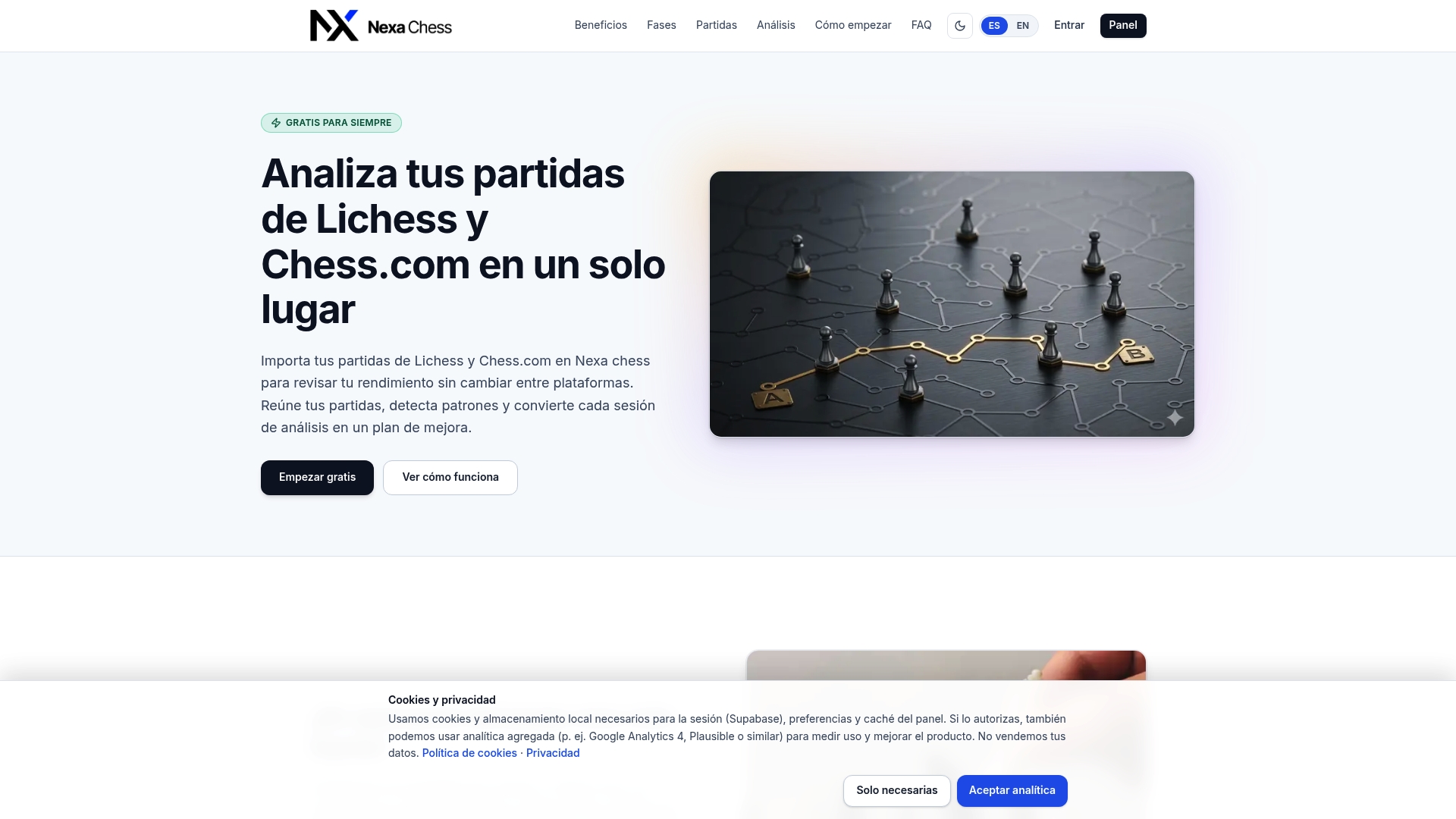
Getting your first opening report takes three steps. Sign up on the Nexa Chess homepage, connect your Lichess or Chess.com account so your games import automatically, then run the opening report to see your ECO breakdown, phase-based Stockfish scoring, and weekly trend view in one screen. From there, the platform highlights the specific lines dragging your score down and the model games worth studying instead of leaving you to build that tree by hand. If you've been meaning to actually fix your opening repertoire instead of vaguely intending to, this is the fastest path from "I think my Sicilian is a problem" to a concrete, prioritized study list. Start with the game import page and you'll have a real answer within your first ten imported games.
Sources
FAQ
What Is the 20/40/40 Rule in Chess?
The 20/40/40 rule is a rough guideline suggesting players split study time into about 20% openings, 40% middlegame, and 40% endgame. It's not a strict formula, but it reflects a common pattern: players tend to over-invest in opening memorization relative to the phases where games are actually decided.
What Is Considered the Worst Opening in Chess?
Openings like the Barnes Opening (1.f3) or the Grob (1.g4) are frequently cited as among the weakest at any serious level, since they weaken the king position and concede central space for no compensation. They can still score surprisingly well in casual or blitz play against unprepared opponents, which is a good illustration of why raw score without context can mislead you.
Do High-Rated Chess Players Tend to Have Higher IQs?
Research on this connection is mixed and doesn't support a clean, direct link between chess strength and general IQ. Chess skill correlates more reliably with deliberate practice, pattern recognition built through repetition, and structured study, which is exactly what opening analysis tools like Nexa Chess are designed to support.
What Is Statistically the Best Chess Opening?
There's no single opening that scores best across all rating levels and time controls. At the top level, 1.e4 and 1.d4 both perform well with sound theory behind them, but the "best" opening for you depends on your own results, which is precisely why checking your personal move-by-move scoring matters more than following a generic ranking.