

FIDE ratings generally run somewhat below your Lichess ratings, with the gap tending to widen as time controls get shorter, such as classical being closest and blitz lower, but specific point values vary across sources. Classical is your best bet for a real estimate since it's the closest match to how FIDE games are actually played. Treat any single number as a range, not a fact.
TL;DR:
- Lichess ratings tend to be higher than FIDE ratings, especially across faster controls, due to differences in time formats and player pools.
- Classical Lichess ratings provide the most accurate range for FIDE estimates, with blitz and rapid ratings offering supporting but less precise guidance.
- Conversion methods rely on regression models based on cross-listed accounts, with classical comparisons showing the tightest correlations.
- Building your own FIDE estimate should start from your classical rating, adjustable with blendings of other formats, and confirmed through recent, stable game samples.
- Online ratings cannot fully replace FIDE numbers because they assess different populations, with online pools containing many casual or low-rated players.
Table of Contents
- Lichess Rating to FIDE Conversion Table and Worked Examples
- How Are These Conversion Numbers Actually Calculated?
- How to Build Your Own Best FIDE Estimate
- How Nexa Chess Refines Your Virtual FIDE Estimate
- Why Lichess Ratings Often Run Higher Than FIDE
- Why Online Ratings Can Never Fully Replace FIDE Numbers
- Peak Rating vs Current Rating: Which One Should You Convert?
- Where to Check Your Actual FIDE Rating
- When a Conversion Estimate Is Useful, and When It Isn't
- Get Your Virtual FIDE Estimate From Your Own Games
- Sources
- FAQ
Lichess Rating to FIDE Conversion Table and Worked Examples
Here's the quick-reference version, built from the offsets that show up consistently across community converter data and cross-platform rating comparisons. Treat every number as a midpoint, not a guarantee.
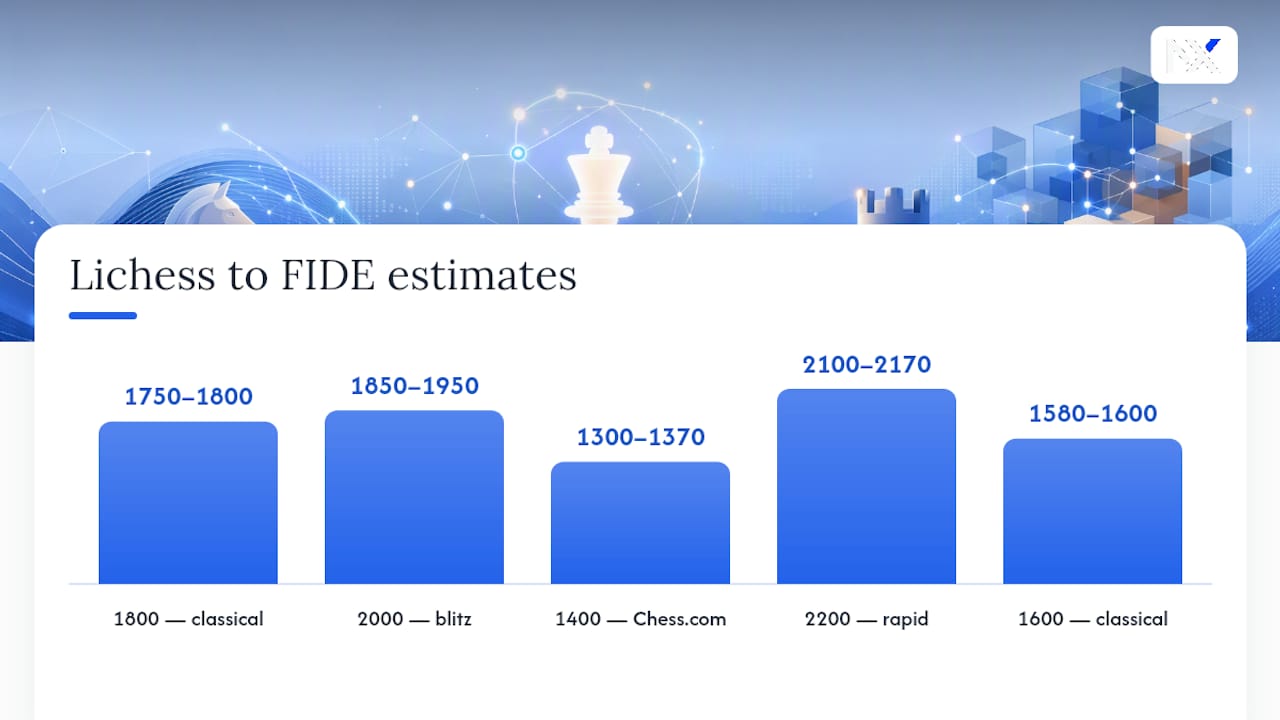
Conversion tables between Lichess ratings and FIDE approximate ranges vary and should be treated as general guidance rather than exact values, since rating systems and player pools differ.
A few worked examples make this concrete:
- A 1800 Lichess classical player likely sits around 1750 to 1800 FIDE. The gap is small because classical time controls behave the most like OTB chess.
- A 2000 Lichess blitz rating maps closer to 1850 to 1950 FIDE. Blitz speed rewards pattern recognition and punishes the slower calculation FIDE games demand, so the discount is steeper.
- A 1400 Chess.com rating (a separate but comparable Glicko-based system) typically lands around 1300 to 1370 FIDE, following the same logic: shorter or less-calibrated formats skew optimistic relative to classical over-the-board play.
- A 2200 Lichess rapid player often estimates out to 2100 to 2170 FIDE, right at the edge where many national federations start awarding expert-level titles.
- A 1600 Lichess classical grinder, if their rating deviation is low and their sample size is large, can trust the tighter end of the range: closer to 1580 to 1600.
The classical column is the one to anchor on. Rapid comes second. Blitz and bullet should be treated as supporting evidence at best, never as your primary estimate.
How Are These Conversion Numbers Actually Calculated?
Conversion tables come from regressions run on players who have both an active Lichess account and an official FIDE rating, cross-referenced by username, federation, or tournament history. One forum-based project built its model from close to 28,000 cross-listed accounts, which is a reasonably large sample by chess-data standards but still tiny compared to Lichess's total user base.
Two statistical approaches dominate this kind of work:
- Linear regression, which fits a straight line between the two rating systems but assumes the relationship between them is uniform across all skill levels.
- Orthogonal distance regression, a method Chess Ratings documents as better suited to conversions because it accounts for measurement error on both axes instead of treating one rating as the fixed, "correct" input.
Statistic Callout: Classical-to-classical comparisons show a noticeably tighter correlation than blitz-to-classical comparisons, and the spread widens as the time control shortens. A blitz rating simply carries more noise relative to FIDE than a classical one does.
Small samples and mismatched time controls are the two biggest sources of error. If a regression is trained mostly on classical pairs, applying it to your bullet rating stretches the model past what it was built to predict. Filtering the dataset by rating deviation (RD) and by recency (dropping stale FIDE entries that haven't been updated in years) meaningfully tightens the output, which is why serious converter projects bother doing it at all.
How to Build Your Own Best FIDE Estimate
A single lookup-table number is a starting point, not a verdict. Here's a workflow that gets you closer to something defensible:
- Start with classical. If you have a Lichess classical rating with a reasonable number of games, use it before anything else. It's structurally the closest match to FIDE play.
- No classical rating? Blend your controls. Weight them roughly as classical > rapid > blitz > bullet, giving the slower formats more influence over your final number.
- Check your rating deviation. A rating built on 15 games swings wildly and should be discounted. A rating built on hundreds of games with a stable RD deserves more trust.
- State a range, not a point. Report your estimate as a midpoint plus or minus 50 to 150 points, and write down which time controls and sample size you used to get there.
Pro Tip: Pull your rating from your most recent 100 rated games instead of your all-time peak. A stable, current window filters out the lucky streaks and rating spikes that make peak numbers misleading.
How Nexa Chess Refines Your Virtual FIDE Estimate
A conversion table gives you a number based on your rating alone. Nexa Chess goes a level deeper by analyzing the games behind that rating.
Import your PGNs from Lichess or Chess.com, and the platform separates them by time control before running each game through Stockfish-backed evaluation. Instead of one blended number, you get phase-by-phase performance data across the opening, middlegame, and endgame.

That distinction matters for accuracy. A player who wins on tactical blunders in the middlegame but plays weak endgames doesn't perform the same way across formats, and a flat rating-to-rating conversion can't see that. Recurring-mistake detection also helps flag when a rating is propped up by opponent errors rather than sound play, which is one of the quieter drivers of online rating inflation. Running a Nexa Chess analysis after you've pulled a table estimate gives you a second, game-level data point to check it against.
Why Lichess Ratings Often Run Higher Than FIDE
Lichess ratings tend to sit above FIDE for reasons that have nothing to do with skill inflation in the way people usually mean it. Lichess uses Glicko-2, a system that adjusts faster to recent results than FIDE's Elo system does, so streaks and slumps show up more dramatically in your number.
The player pool matters just as much as the formula. Lichess's rating pool includes enormous numbers of casual, inactive, or deliberately low-rated accounts (smurfs, beginners who never returned, players testing new openings on throwaway profiles). That drags the overall pool's average down, which pushes everyone else's relative rating up compared to a FIDE pool made almost entirely of players who took the trouble to register with a federation and play rated tournaments.
Time control compounds the effect. Faster games reward instinct and pattern recognition over the deep calculation FIDE classical games demand, and players who are strong at bullet or blitz frequently overperform their "true" classical strength in the ratings that measure it. That's the core reason blitz and bullet carry the largest downward adjustments in any FIDE conversion table: the format itself inflates the number relative to what would hold up over a slower board.
Why Online Ratings Can Never Fully Replace FIDE Numbers
Online and FIDE ratings measure performance against fundamentally different populations, and that gap is the real limitation behind every conversion table. FIDE ratings reflect results against other federation-registered, tournament-tested players in a relatively closed, verified pool. Lichess ratings reflect results against millions of anonymous accounts of wildly uneven quality, commitment, and honesty.
There's no official one-to-one formula between the two systems, and there likely never will be, because the systems aren't measuring the same thing with the same instrument. FIDE uses classic Elo with periodic updates; Lichess runs Glicko-2, which factors in rating deviation and volatility on every game. Chess.com uses its own Glicko variant. Each produces a number that behaves differently at the tails: offsets compress at high ratings, where both pools are thinner and more serious, and expand at low ratings, where the online pool is flooded with casual and unrated-adjacent play.
Time-of-day effects, anti-cheat enforcement differences, and even server-specific quirks add further noise that a conversion table can't correct for. None of that makes an online rating meaningless. It just means treating it as a rough proxy, not a substitute, for the number that actually counts on official rating lists.
Peak Rating vs Current Rating: Which One Should You Convert?
Your peak Lichess rating and your current Lichess rating can produce noticeably different FIDE estimates, and conflating the two is one of the most common mistakes players make when self-assessing strength.
A peak rating usually reflects a short hot streak, favorable matchups, or a run against a temporarily soft field. It's real, but it's also the least stable number in your entire rating history, and converting it directly tends to overstate what you'd actually score against a room of federation-rated opponents over a multi-round tournament. Your current rating, especially if it's been stable across your last 50 to 100 games, is a far more honest signal of sustained strength.
This is exactly why the workflow above recommends anchoring your estimate to a recent, stable window rather than an all-time high. If your peak sits at 1850 but you've spent the last three months oscillating between 1720 and 1760, your realistic FIDE conversion should be built from the 1720 to 1760 range, not the peak. Coaches and tournament organizers who eyeball Lichess ratings to gauge section placement generally look at recent form for the same reason: a stale peak tells them what you once did, not what you're likely to do next weekend.
Where to Check Your Actual FIDE Rating
If you already hold a FIDE rating, the only place to verify it is the official FIDE ratings database, searchable by name, country, or FIDE ID. It updates monthly and reflects your rating after your most recently rated FIDE-sanctioned events.
If you don't yet have a FIDE rating, your national federation's website is the next stop. Federations list which local tournaments are FIDE-rated, what the norm and registration requirements look like, and how to get your first official rating on the books. For players in England, the English Chess Federation publishes its own conversion guidance between domestic ratings and FIDE, which is a useful model for how conservative and transparent an official conversion policy can be. Other federations publish similar guidance; check yours before assuming a generic online rule of thumb applies to your national system.
When a Conversion Estimate Is Useful, and When It Isn't
Conversion tables earn their keep in planning: picking a tournament section, deciding if you're ready to hire a titled coach, or tracking whether your training is actually moving the needle over months. For those decisions, a range is plenty.
They stop being useful the moment norms, titles, or official standing are on the line. No estimate, however well built, substitutes for rated results on the FIDE list. If you're serious about an official number, the next step is straightforward: find a FIDE-rated tournament through your federation and play it.
— carles
Get Your Virtual FIDE Estimate From Your Own Games
Most conversion tools stop at your rating number. Nexa Chess starts with your actual games. Import your history from Lichess or Chess.com, and instead of one generic offset, you get a Stockfish-backed breakdown by opening, middlegame, and endgame that feeds into a virtual FIDE estimate built from how you actually play, not just where your rating sits on a chart.

The platform is free forever, with no credit card and no trial clock running out on you. If you've already ballparked your FIDE equivalent from the table above, running your games through Nexa Chess is the natural next step to confirm it, sharpen it, or find out exactly which phase of the game is costing you rating points.
Sources
- Online Rating vs FIDE Rating: a clear, practical guide
- Chess Rating Converter — Chess.com to Lichess, FIDE, USCF
- Lichess
- Recommended conversion of ECF to FIDE ratings (English Chess Federation)
FAQ
What Is a 2000 Lichess Rating in FIDE?
A 2000 Lichess classical rating typically converts to roughly 1950 to 2000 FIDE, while 2000 in blitz or bullet trends closer to 1850 to 1950 FIDE due to the larger discount those faster formats require.
Is an 1800 Rating on Lichess Good?
An 1800 Lichess classical rating is solid club strength and converts to roughly 1750 to 1800 FIDE, which is comparable to an experienced tournament player in most national systems.
How Much Is a 1400 Chess.com Rating in FIDE?
A 1400 Chess.com rating generally converts to around 1300 to 1370 FIDE, following the same logic as Lichess conversions since both platforms use Glicko-based systems that run ahead of classical FIDE Elo.
Is 1700 a Good Lichess Rating?
A 1700 Lichess rating, especially in classical or rapid, is above average for the platform and converts roughly to a FIDE range near the low to mid 1600s to low 1700s, putting it in solid intermediate club-player territory.
Does Nexa Chess Calculate an Official FIDE Rating?
No. Nexa Chess produces a virtual FIDE estimate based on Stockfish analysis of your imported games, which is useful for tracking and planning but is not a substitute for an official rating from a FIDE-sanctioned tournament.