

Chess.com Rapid ratings run roughly 150 to 200 points above FIDE standard ratings for most players, though that gap shrinks near the top and widens near the bottom. Use your Rapid rating, not Blitz or Bullet, as your reference point. Treat any conversion as a range, not a verdict, because sample size and playing pool differences make exact translations impossible.
TL;DR:
- Chess.com Rapid ratings typically underestimate FIDE ratings by about 150 points, with the conversion range shrinking at higher levels and expanding at lower ones.
- The best online proxy for FIDE standard ratings is Chess.com Rapid, but conversions can be unreliable below 1000, and fewer than 50 games make estimates less trustworthy.
- Conversion models are approximate due to sampling bias, provisional ratings, and online cheating, resulting in error margins of around 100 points or more.
- To turn an online estimate into an official FIDE rating, players must compete in rated over-the-board tournaments with a minimum number of FIDE-registered games.
- Virtual tools like Nexa Chess analyze recent games with Stockfish to track progress and identify weaknesses, but they do not replace official FIDE ratings obtained through sanctioned play.
Table of Contents
- How to Convert a Chess.com Rating to FIDE (With Examples)
- Why Conversion Models Are Never Exact
- Rapid, Blitz, or Bullet: Which Rating Actually Predicts FIDE?
- Converting Your Number, Then Confirming It Over the Board
- How Nexa Chess Estimates Your Virtual FIDE Strength
- When a Conversion Helps, and When It Doesn't
- Track Your Progress Toward a Real FIDE-Level Game
- Sources
- FAQ
How to Convert a Chess.com Rating to FIDE (With Examples)
There's no official formula for turning a Chess.com rating into a FIDE number. What exists instead is community-built regression modeling on paired profiles: players who have both a Chess.com account and an official FIDE rating. An analysis of roughly 50,000 such profiles produced the estimates most converters now rely on, and they hold up as a reasonable starting point for anyone curious where they'd land over the board.
The table below shows central estimates and the uncertainty range around them, not a single fixed answer.
| Chess.com Rapid | Estimated FIDE Standard | Uncertainty Range |
|---|---|---|
| 1400 | ~1050 | 950–1150 |
| 1500 | ~1275 | 1200–1350 |
| 1600 | ~1425 | 1350–1500 |
| ~1850 | ~1650 | 1550–1750 |
| ~1855 | ~1855 | ~1850–1910 |
| 2200 | ~2100 | 2050–2150 |
A few things to keep in mind when reading it:
- The center column is a best guess, built from averages across thousands of profiles. Your actual result could sit anywhere in the range next to it.
- The gap between Rapid and FIDE standard isn't constant across the scale. It compresses at higher ratings and widens lower down, so a flat "subtract 150" rule breaks down fast at either end.
- Estimates below roughly 1000 Chess.com Rapid get shaky fast. FIDE's rating floor starts at 1400 for standard ratings, so anyone estimating below that is extrapolating past where FIDE data even exists.
- If your Rapid rating comes from fewer than 50 games, treat the whole exercise as a rough guess rather than a data point.
Why Conversion Models Are Never Exact
These conversions come from pairing a player's Chess.com profile with their official FIDE record, then running a regression fit across thousands of matched pairs. Some tools go a step further and use orthogonal-distance regression instead of standard least-squares fitting, a technique that keeps the conversion consistent whether you're going from Chess.com to FIDE or back the other way. Ordinary regression can produce mappings that contradict themselves depending on direction; orthogonal fitting largely avoids that.
Even with better math, the underlying data has real limits:
- Sampling bias skews the results, since players who bother linking their FIDE ID to Chess.com tend to be more serious, active competitors than the average online player.
- Provisional ratings on either platform, especially early FIDE ratings built on very few games, add noise that regression can't fully filter out.
- Engine-assisted cheating on some online accounts inflates Chess.com numbers in ways that never show up in an OTB rating.
Studies pairing rating pools typically report error margins of 100 points or more at a given rating point, which is exactly why the table above shows ranges instead of single numbers. A converter that hands you one precise digit is hiding that uncertainty, not eliminating it.
Rapid, Blitz, or Bullet: Which Rating Actually Predicts FIDE?
Chess.com Rapid is the closest single proxy for FIDE standard, and it's not particularly close competition. FIDE standard games run at classical time controls, typically 90 minutes or more with increments, and Rapid (10 to 60 minutes on Chess.com) shares more of that decision-making rhythm than anything faster.
Blitz and Bullet ratings measure a different skill set almost entirely. Speed, pattern recognition under pressure, and pre-move habits matter more than the deep calculation that decides classical games. A player can carry a 2200 Bullet rating and struggle to break 1700 in a real FIDE standard event, because the games test different muscles.
That said, Blitz and Bullet aren't useless. They're worth checking when:
- Your Rapid sample is small (under 30 to 50 games) and too volatile to trust on its own.
- You want a secondary signal to confirm whether your Rapid number reflects genuine strength or a lucky streak.
Pro Tip: Before trusting your Rapid rating for any comparison, check its games-played count and recent volatility on Chess.com's stats page. A rating that's swung 200 points in the last month tells you far less than one that's held steady for 100+ games.
Converting Your Number, Then Confirming It Over the Board
Getting a working estimate takes a few minutes. Turning that estimate into a real FIDE rating takes tournament play. Here's the practical sequence:
- Find your current Chess.com Rapid rating and note your total games played at that time control.
- Locate your rating on the conversion table and read both the central estimate and the range around it, not just the middle number.
- Weight your confidence based on sample size. Fewer than 50 games means treat the range as a loose guess; 200 or more games means the estimate is more dependable.
- Search for a local FIDE-rated tournament through your national chess federation or FIDE's own event listings.
- Play your qualifying games. FIDE requires a minimum number of rated games against already-rated opponents before it publishes your first official rating.
- Expect a real adjustment once you play. Classical time controls, physical boards, and no takebacks all expose different weaknesses than online blitz-adjacent Rapid does.
If your estimated range spans 150 points or more, don't anchor to the top of it. Assume you're closer to the middle or lower end until actual results say otherwise. Nobody's FIDE debut has ever matched their online rating on the nose.
How Nexa Chess Estimates Your Virtual FIDE Strength
The platform imports your games directly from Chess.com and Lichess, then runs them through Stockfish-based analysis to break down performance by phase: opening, middlegame, and endgame. That phase-specific view is what separates a virtual FIDE estimate from a flat conversion table lookup.
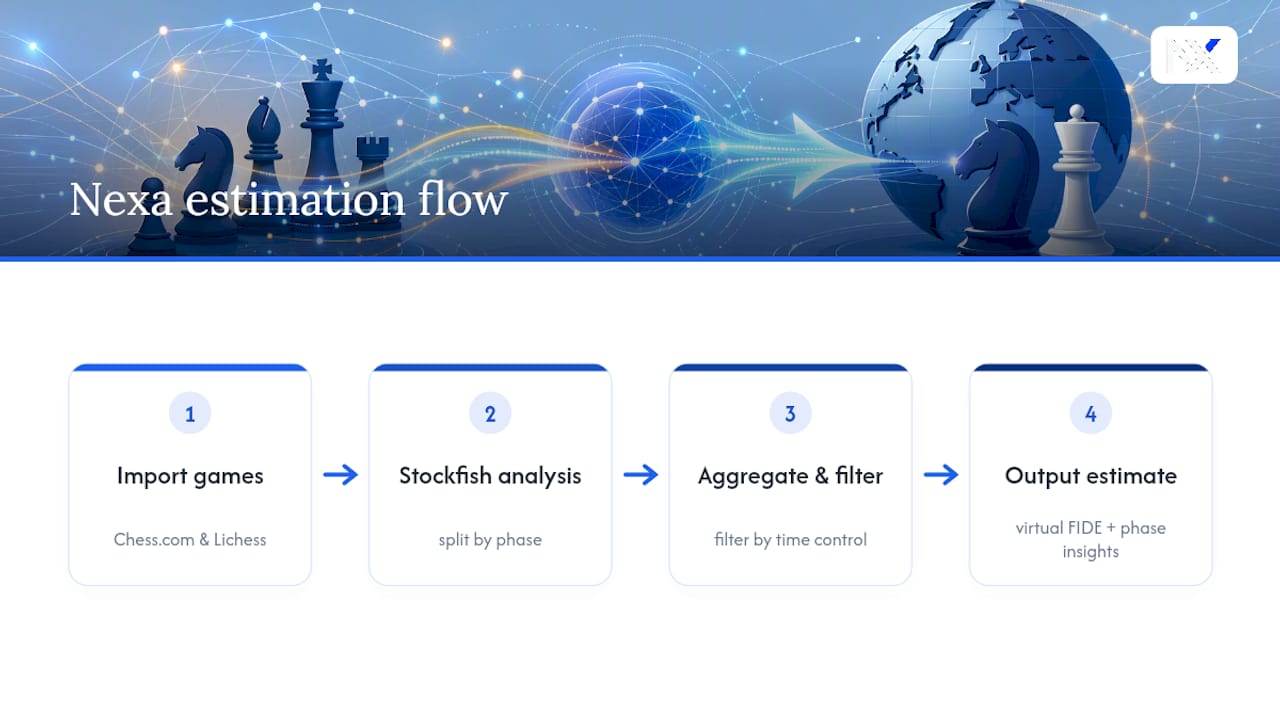
Instead of just plugging your Rapid number into a formula, Nexa Chess aggregates engine evaluations across your recent games, filters by time control, and tracks how your accuracy shifts week to week. That combination produces a virtual FIDE-equivalent estimate alongside a clearer picture of which part of your game is actually costing you rating points.
Worth being upfront about: a virtual estimate, however it's calculated, is a benchmarking tool. It helps you decide where to focus study time and whether you're trending up or down. It does not replace an official FIDE rating, which only comes from playing rated games against rated opponents in sanctioned events.
When a Conversion Helps, and When It Doesn't
Converters and virtual estimates are genuinely useful for tracking your own progress over time, satisfying curiosity about where you'd land, or getting a rough sense of match difficulty against a FIDE-rated opponent you might face online. They're the wrong tool entirely for anything official.
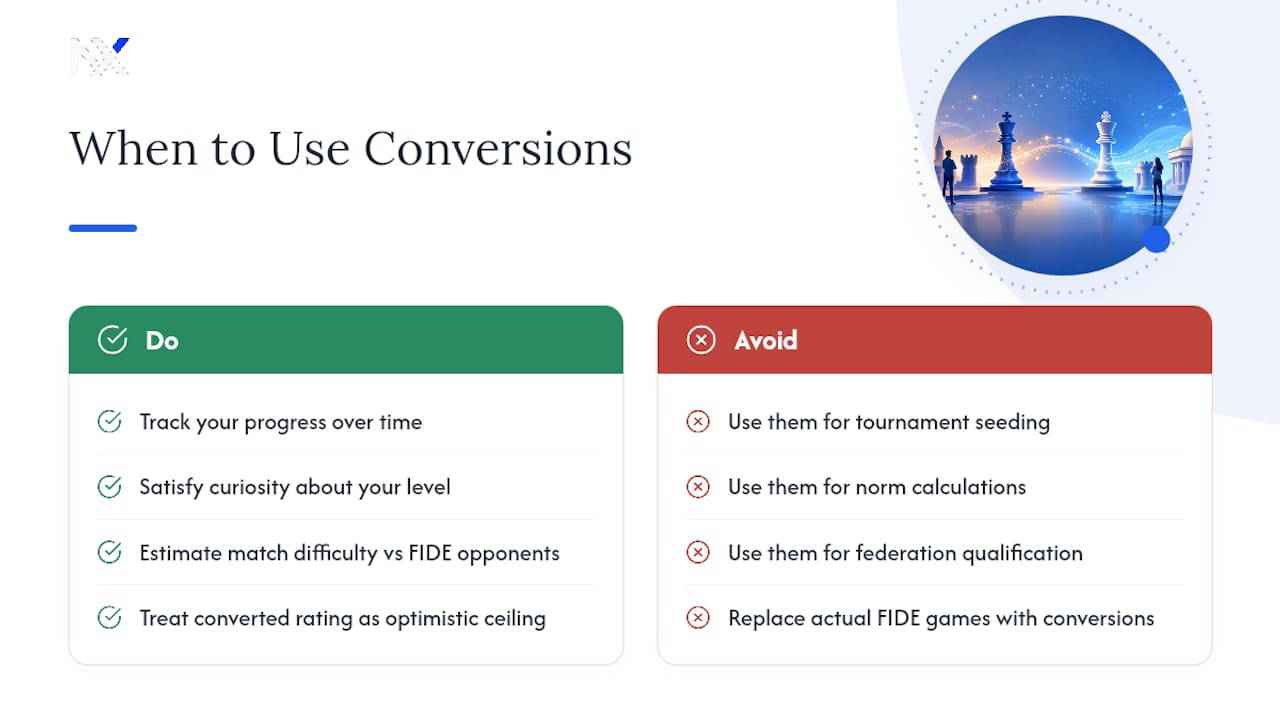
If you need a rating for tournament seeding, norm calculations, or federation qualification, no conversion table substitutes for actual FIDE games. The error margins are simply too wide for anything with real stakes attached.
My practical rule: treat every converted number as the top of a range you might reach, not the floor you're standing on. Assume less, not more, until an arbiter's result sheet says otherwise.
— carles
Track Your Progress Toward a Real FIDE-Level Game
Knowing your estimated range is one thing. Actually closing the gap between your Chess.com Rapid rating and a stronger FIDE-level game is another, and that's where a generic conversion table stops being useful. This tool picks up where the table leaves off by analyzing the actual games behind your rating.

Import your games from Chess.com or Lichess, and the platform runs each one through Stockfish to flag recurring mistakes by phase, opening line, and endgame pattern. Instead of a static number, you get a weekly trend showing whether your virtual FIDE estimate is climbing or stalling, and exactly which part of your game is holding it back. It's built for the study side of the equation, not as a replacement for the tournament hall. When you're ready to see where your own games place you, analyze your games on Nexa Chess and start tracking the trend instead of guessing at a single number.
Sources
FAQ
How much is a 1400 Chess.com rating in FIDE?
A 1400 Chess.com Rapid rating typically converts to roughly 1050 FIDE standard, though the realistic range runs from about 950 to 1150 depending on games played and sample reliability.
Is a 1300 Chess.com rating good?
A 1300 Chess.com Rapid rating puts you solidly in the beginner-to-improving range, likely translating to below FIDE's rating floor for newly rated players, which starts at 1400.
What is a 1600 rating on Chess.com equivalent to in FIDE?
A 1600 Chess.com Rapid rating typically maps to around 1425 FIDE standard, with a realistic range of roughly 1350 to 1500 depending on how many rated games back up that number.
Is 700 Elo on Chess.com good?
A 700 Chess.com Rapid rating sits at the very early beginner level and falls well below any meaningful FIDE comparison, since FIDE doesn't publish standard ratings under 1400. It's a starting point, not a benchmark worth converting yet.
Can a tool like Nexa Chess replace an official FIDE rating?
No. Nexa Chess produces a virtual FIDE-equivalent estimate from your Chess.com and Lichess games using Stockfish analysis, which is useful for tracking improvement, but only playing rated games in sanctioned FIDE events produces an official rating.