
Stop the rated game right now and run a short reset: 90 seconds of box breathing. Close the tab or app, and take a 5 to 10 minute break before you queue again. This halts the neurochemical cascade that's already wrecking your calculation. Chasing an immediate win to "fix" the last loss almost always costs you more rating than the pause would.
TL;DR:
- Players are more likely to lose immediately after a previous defeat, especially during online play, due to emotional and neurological tilt effects.
- Recognizing signs of tilt involves noticing rushed moves, irritability, or racing clock times, and specific tilt flavors like blunder tilt or rating tilt.
- The key to recovery is pausing for 90 seconds with controlled breathing and then taking 5 to 10 minutes to reset physically and mentally before returning to play.
- Applying the two-loss rule and analyzing emotional states during losses help prevent tilt from escalating into long streaks of poor performance.
- Tools like Nexa Chess can monitor tilt patterns by analyzing game mistakes and error spikes, providing targeted insights to improve mental resilience over time.
Table of Contents
- What Is Chess Tilt and Why Does It Happen?
- How Do You Know You're Tilting?
- What Should You Do in the First 90 Seconds and 10 Minutes?
- How Do You Return to Play Without Relapsing?
- How Can You Reduce Tilt Over the Long Term?
- How Does Game Analysis Reveal Your Tilt Patterns?
- A Coach's Honest Take on Tilt
- See Your Own Tilt Patterns With Nexa Chess
- Sources
- FAQ
What Is Chess Tilt and Why Does It Happen?
Chess tilt is a state of impaired decision-making triggered by frustration, usually after a loss, a blunder, or a string of bad luck. The word comes straight from poker, where players use it to describe emotionally-driven bad decisions at the table. Chess adopted the term because the pattern is identical: a bad result spikes emotion, and emotion overrides judgment.
The mechanism is neurological, not a character flaw. A loss or a blown position activates the amygdala, the brain's threat-detection center, while reducing activity in the prefrontal cortex, the region responsible for calculation and impulse control. Cortisol floods your system. Attention narrows. This emotional peak runs roughly 90 seconds before it starts to decay, which is why the first move you make after a disaster is often the worst one on the board.
This isn't speculation. An analysis of over one million online chess games found a statistically significant sequence effect: players are measurably more likely to lose a game right after losing the previous one, with a correlation strong enough (p < 2.22e-16) that chance is not a plausible explanation. The effect fades over several games but doesn't vanish instantly, which is exactly why a quick "one more game" mentality backfires.
Online play makes it worse. The instant matchmaking, the visible rating number ticking down in real time, and the anonymity of playing a stranger all remove the natural cooldown that used to exist between over-the-board games.
How Do You Know You're Tilting?
Tilt shows up in patterns you can actually catch if you're watching for them.
In-game signs:
- Rushing moves without checking forcing lines
- Tunnel vision on one idea while ignoring your opponent's threats
- Sudden, uncharacteristic aggression or unnecessary piece sacrifices
- Abandoning your usual openings for something unfamiliar mid-session
- Burning or wasting clock time erratically
Between-games signs:
- An urge to immediately queue for another game
- Replaying the loss in your head instead of reviewing it
- Irritability that has nothing to do with chess
Tilt also has flavors. Blunder tilt hits after you miss something obvious and spend the next game trying to "prove" you're better than that mistake. Injustice tilt follows a loss you feel wasn't fair (a disconnection, a lag spike, an opponent removing). Rating tilt kicks in when you watch the number drop and start playing to protect it instead of playing the position. Opponent tilt happens when a specific playing style, like relentless flagging or trolling in chat, gets under your skin.
Pro Tip: Ask yourself three questions before your next move: Am I playing this position, or am I playing my anger? Would I make this move if my rating were hidden? Have I taken a full breath in the last 30 seconds? If any answer worries you, that's your signal to stop.
What Should You Do in the First 90 Seconds and 10 Minutes?
The first 90 seconds after a tilting moment decide whether you spiral or recover. Here's the sequence, in order:
- Stop. Don't click "new game." Don't touch the board again immediately.
- Breathe. Use box breathing: inhale for 4 seconds, hold for 4, exhale for 4, hold for 4. Repeat for the full 90 seconds. This is long enough for the amygdala's initial surge to start decaying and prefrontal control to return.
- Close it. Shut the chat window, minimize the tab, or lock your phone. Removing the visual trigger matters more than people expect.
From there, extend the reset to 5 to 10 minutes:
- Stand up and move. A short walk or even stretching pulls blood flow and attention away from the threat response.
- Hydrate. Dehydration compounds mental fatigue, which compounds tilt.
- Do something unrelated and low-stakes for a few minutes, like checking a message or making coffee.
- Actively interrupt rumination. If you catch yourself replaying the loss, name it out loud: "I'm ruminating," then redirect.
Adopt the two-loss rule: after two losses in a row, you're done for the session, full stop. This is a common recommendation among chess psychology coaches, and it works because it removes the decision from a moment when you're least equipped to make it well.
Pro Tip: Set a literal timer on your phone labeled "cooldown" the moment you lose. Some players also keep a second, unrated "analysis-only" account specifically for reviewing losses without the temptation to immediately queue again.
How Do You Return to Play Without Relapsing?
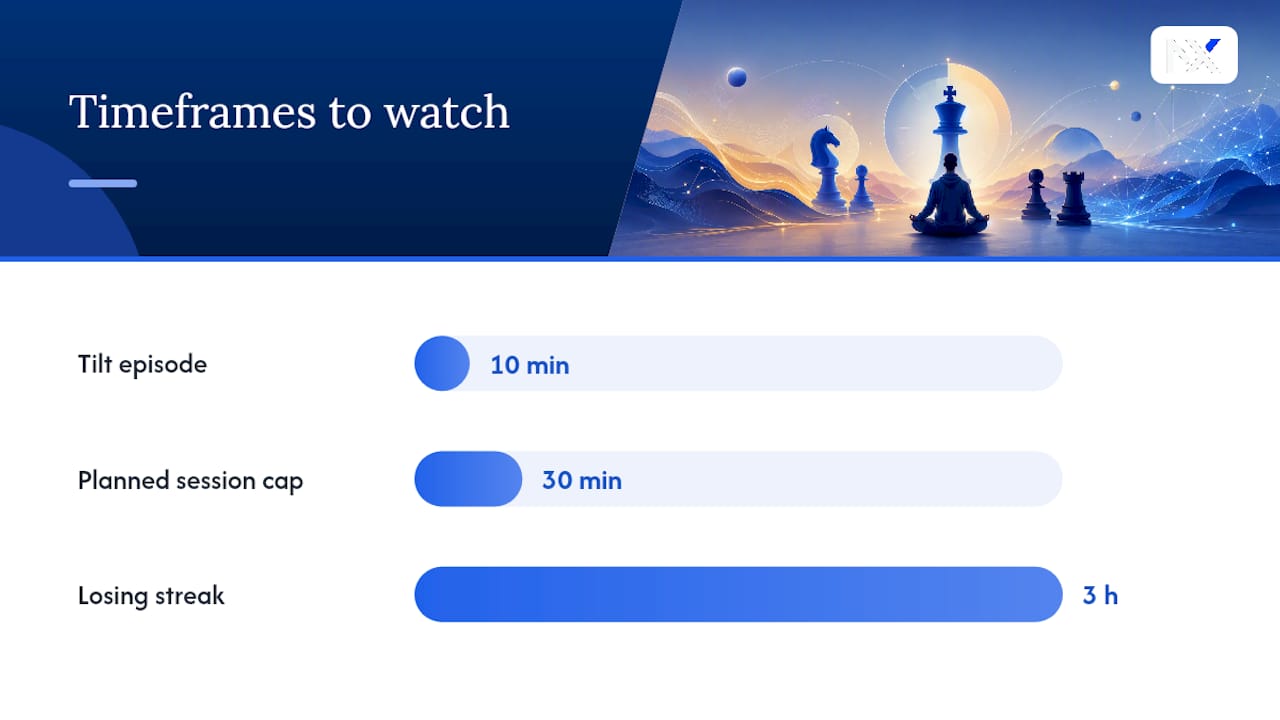
Coming back too soon is how a 10-minute tilt turns into a three-hour losing streak. Run this checklist before you touch another rated game:
- Baseline mood check. Are you calm, or are you still replaying the last loss? Be honest.
- Set a small, specific objective for the next game, like "castle by move 10" rather than "win."
- Cap the session length in advance. Decide you'll play for 30 minutes or five games, whichever comes first, before you start.
Warm back in instead of jumping straight into a rated match. Solve 5 to 10 tactical puzzles to rebuild pattern recognition without the emotional stakes. Or play one casual, unrated game as a buffer. A calm, unhurried review of the loss that started the tilt works too, as long as you're reviewing it, not reliving it.
Some signs mean you shouldn't play again today at all: a racing heart when you think about the app, a flat refusal to consider you might have been wrong in the loss, or catching yourself already rehearsing excuses for the next defeat. Those are longer-pause signals, not 10-minute ones.
When you do sit down to analyze the loss that triggered everything, look past the tactical error. Ask what emotional state you were in when it happened. Were you impatient? Overconfident? Anxious about the clock? That context turns one bad game into useful data instead of just another loss to forget.
How Can You Reduce Tilt Over the Long Term?
Tilt frequency drops when you treat it as a pattern to map, not a mood to endure. Keep a short tilt log, just a line or two after each session noting what triggered frustration and how you responded. Over a few weeks, recurring triggers become obvious.
Match your training to the trigger. If blunder tilt is your pattern, drill quick tactical puzzles under mild time pressure to rebuild composure after mistakes. If preparation gaps trigger you (getting caught in an unfamiliar line), spend sessions specifically shoring up your opening repertoire instead of grinding more games.
Session design matters as much as mindset. Mix time controls so you're not locked into one high-pressure format for hours. Schedule breaks before you need them, not after tilt has already started. Cap consecutive rated games at a number you decide in advance, before your emotions do it for you.
Cognitive reappraisal, reframing a loss as information rather than a verdict on your ability, is a practice you build over time, not a switch you flip. Micro-journaling a sentence after each session and reviewing your trends weekly turns scattered frustration into a visible trajectory.
| Long-term habit | What it targets | How often |
|---|---|---|
| Tilt log entry | Identifying recurring triggers | After every session |
| Trigger-specific drills | The exact skill gap behind your tilt type | 2 to 3 times weekly |
| Mixed time controls | Preventing format fatigue | Rotate weekly |
| Weekly trend review | Spotting patterns before they repeat | Once a week |
How Does Game Analysis Reveal Your Tilt Patterns?
Your games already contain the evidence. A spike in error rate right after a loss, a cluster of mistakes concentrated in one phase of the game, or erratic time usage in the moves following a bad result all point to tilt, not just a bad day.
A practical workflow looks like this:
- Import your recent games from Lichess or Chess.com into one place instead of scattered across platforms.
- Tag the emotional context of each session (tilted, calm, rushed) so patterns become searchable later.
- Run a phase-based analysis to see whether your errors cluster in the opening, middlegame, or endgame after a loss.
- Set a micro-goal tied to whatever the data shows, like reducing endgame blunders in your next five games.
- Track the trend weekly instead of judging yourself off a single session.
This is exactly the gap Nexa Chess fills. It imports your games from both platforms, runs Stockfish-based phase analysis to isolate where mistakes concentrate, and highlights recurring errors so a tilt pattern shows up as a chart, not a vague feeling. Weekly trend exports turn that data into a targeted practice block instead of another aimless training session.
A Coach's Honest Take on Tilt
Tilt cost me rating for years before I stopped treating it as weakness and started treating it as data. The habit that changed things: the moment I feel the urge to immediately requeue, I write one sentence about what just happened before I touch another game. That pause alone stops most spirals before they start.
— carles
See Your Own Tilt Patterns With Nexa Chess
Most players suspect they tilt but have never actually seen it in their own numbers. This type of tool imports games from Lichess and Chess.com, runs Stockfish analysis across the opening, middlegame, and endgame, and flags the recurring mistakes that cluster right after a loss.

Instead of guessing whether you're on tilt, you get a weekly trend chart showing your error rate spike (or not) after tough losses, plus an estimated FIDE rating pulled from your actual games, according to the platform. That's a very different starting point than replaying a loss in your head and hoping you remember the lesson next time. If you want a workflow to log decisions the way tilt-aware players track betting or performance data, tools like Betlog apply the same discipline of recording outcomes instead of relying on memory.
Nexa Chess is free forever, no credit card required. Import your last month of games and run your own tilt check this week; the dashboard will show you, in your own data, exactly when and where your play falls apart.
Sources
- Tilt and Hype in Online Chess (Seán Devine)
- Chess
- Chess Psychology: Master the Mental Game – ChessSolve
- Chess rage and ragequit: The brain circuits behind tilt (Blog Dungaucher)
FAQ
How Do You Get Rid of Chess Tilt?
Stop playing rated games immediately and run a 90-second breathing reset, then take a 5 to 10 minute break before deciding whether to continue. Following the two-loss rule, stopping entirely after two consecutive losses, prevents the spiral from compounding.
Why Is It Called "Tilting"?
The term originated in poker, describing the mechanical tilt of an old pinball machine when a player shook it too aggressively, causing the game to malfunction. Chess players adopted the word because the pattern is the same: frustration causes decisions to malfunction, not just the machine.
How Do You Avoid Tilt in the First Place?
You reduce tilt frequency by capping session length in advance, mixing time controls so you're not stuck in one high-pressure format, and scheduling breaks before frustration forces them. Keeping a short tilt log to spot your specific triggers, whether it's blunders, rating drops, or certain opponents, lets you train the actual weak point instead of just grinding more games.
How Do You Get Out of Tilt Once You're In It?
Close the app or tab immediately, breathe using a box-breathing pattern for 90 seconds, and physically move, stand, stretch, or get water, for the next several minutes. Reviewing a recent loss with Nexa Chess afterward can also help you see exactly where your errors clustered, turning a frustrating session into a specific training target rather than a mystery.