
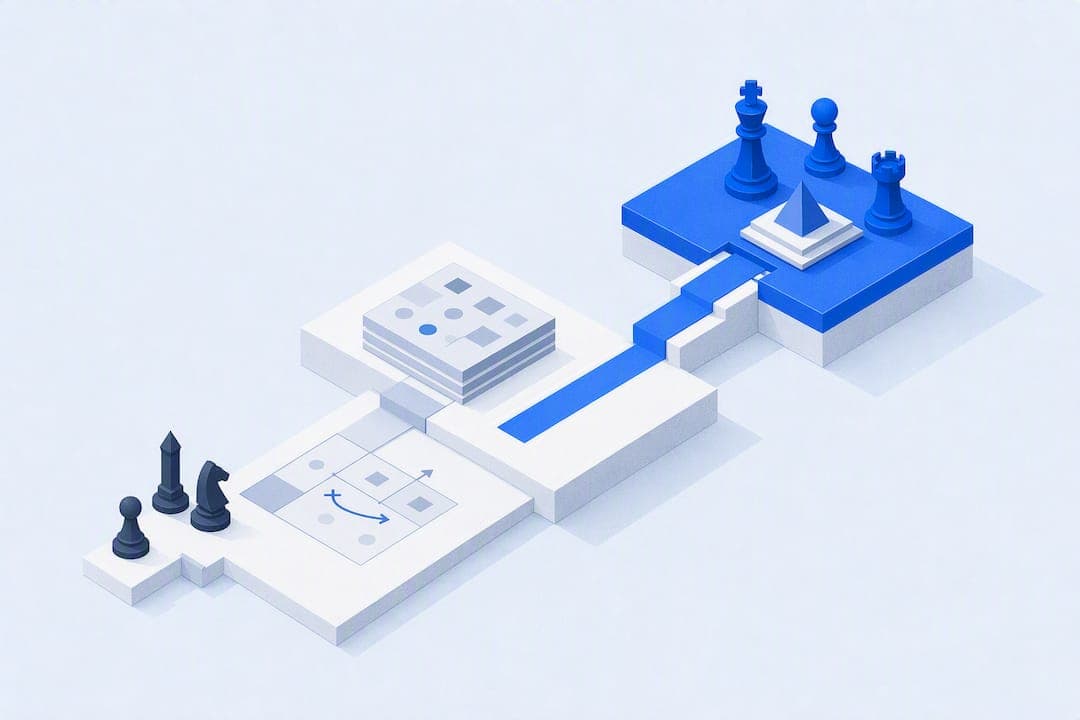
A Stockfish-powered analysis of your PGN or Lichess/Chess.com game shows every move's evaluation, flags your blunders, and gives you enough material to build a focused study plan in under 30 minutes. Upload the game or fetch it by username, let the engine run, and read the report for one or two mistakes that keep repeating. That pattern, not any single blunder, is what you fix first.
TL;DR:
- Moves with high centipawn loss typically signal inaccuracies, but the context, such as game stage or position, critically affects their significance.
- Repeated mistakes across multiple games reveal your real weaknesses, not individual blunders, guiding focused improvement rather than chasing every engine suggestion.
- Analyzing several games over time helps identify recurring patterns, especially in endgames or openings, which are more impactful for growth than isolated errors.
- Deep analysis should be reserved for decisive or problematic games, while shallow passes effectively identify common mistakes and patterns in overall play.
- Consolidating game data with tools like Nexachess saves time and clarifies recurring themes across your entire game history, improving your strategic focus.
Table of Contents
- What a Chess Game Analysis Report Actually Shows You
- How to Import and Run Your First Analysis
- Reading Centipawn Loss, Accuracy, and Recurring Mistakes
- From Report to Practice: A Weekly Study Plan
- How Nexachess Turns These Habits Into One Workflow
- Where Engines Help and Where Human Judgment Still Wins
- Start With Nexachess: Import Your First Game Today
- Tools Worth Bookmarking for Deeper Verification
- Sources
- FAQ
What a Chess Game Analysis Report Actually Shows You
Every solid game analysis report is built around the same handful of fields, whether it comes from a browser extension or a dedicated platform. Knowing what each one measures lets you judge any tool's output in seconds instead of guessing.
The engine evaluates each position after your move and compares it to its own best line, expressed in centipawns (hundredths of a pawn). The gap between the two is your centipawn loss for that move. Stack up centipawn loss across the whole game and most tools convert it into an accuracy percentage, a single number meant to summarize how closely you played to the engine's ideal line.
Stockfish, the open-source engine behind most free and paid analysis tools, runs the same evaluation math regardless of which site wraps around it. The differences between analyzers usually come down to interface and workflow, not raw engine strength.
Beyond the headline accuracy number, a useful report typically includes:
- Move tags such as blunder, mistake, inaccuracy, and occasionally brilliant or best move
- An evaluation graph plotting the game's swing from move one to checkmate or resignation
- Opening identification by ECO code, so you know exactly which line you played and where it diverged from theory
- Endgame classification, flagging themes like rook endgames, opposite-colored bishops, or pawn races
Skim the evaluation graph before anything else. A steep drop marks the moment the game actually turned, and that single moment is usually worth more study time than every smaller mistake combined.
How to Import and Run Your First Analysis
Running a report is mechanically simple, but a few choices along the way affect how useful the output ends up being.
- Get the game into the tool. You can paste a PGN file directly, upload a FEN snapshot of a single position, or connect your Chess.com or Lichess username so the platform pulls recent games automatically. Username import saves time if you're analyzing several games in one sitting.
- Pick engine depth. Deeper search catches more subtle tactical resources but takes longer per move. For a quick pass through ten games, a shallower depth is fine. For the one game that decided a tournament round, let it run deeper.
- Enable move-by-move review. Most tools let you step through the game one move at a time, comparing your choice against the engine's top two or three candidates. Click into the critical moments the evaluation graph flagged rather than reading every move in order.
- Check alternate lines. When the engine disagrees with your move, expand the variation to see how far the position actually diverges. Sometimes the "better" move only gains a few centipawns and isn't worth memorizing.
- Export or save the annotated game. Keep a naming convention (opponent, date, opening) and tag recurring themes so you can pull up "all games where I lost material in the endgame" later.
Pro Tip: Don't run every game at maximum depth just because you can. Reserve deep analysis for games you lost or drew when you expected to win. A shallow pass is plenty for a game you dominated.
Reading Centipawn Loss, Accuracy, and Recurring Mistakes
Numbers on a report only help if you know what they're actually telling you.
Centipawn loss under roughly 10 to 20 per move is generally considered normal even for strong players. Larger losses often signal inaccuracies or blunders, depending on the position and context. Context matters more than the raw number: a 90 centipawn loss in an already-lost position means far less than the same number on move 15 of an even game.
Accuracy percentage is a useful summary but not a diagnosis. It compresses an entire game into one figure, which means a single catastrophic blunder in an otherwise clean game can produce the same score as a game full of small, steady drift. Engines also suffer from a horizon effect: they evaluate to a fixed search depth and can miss long-term positional problems that only matter ten or fifteen moves later, particularly in closed or fortress-like positions.
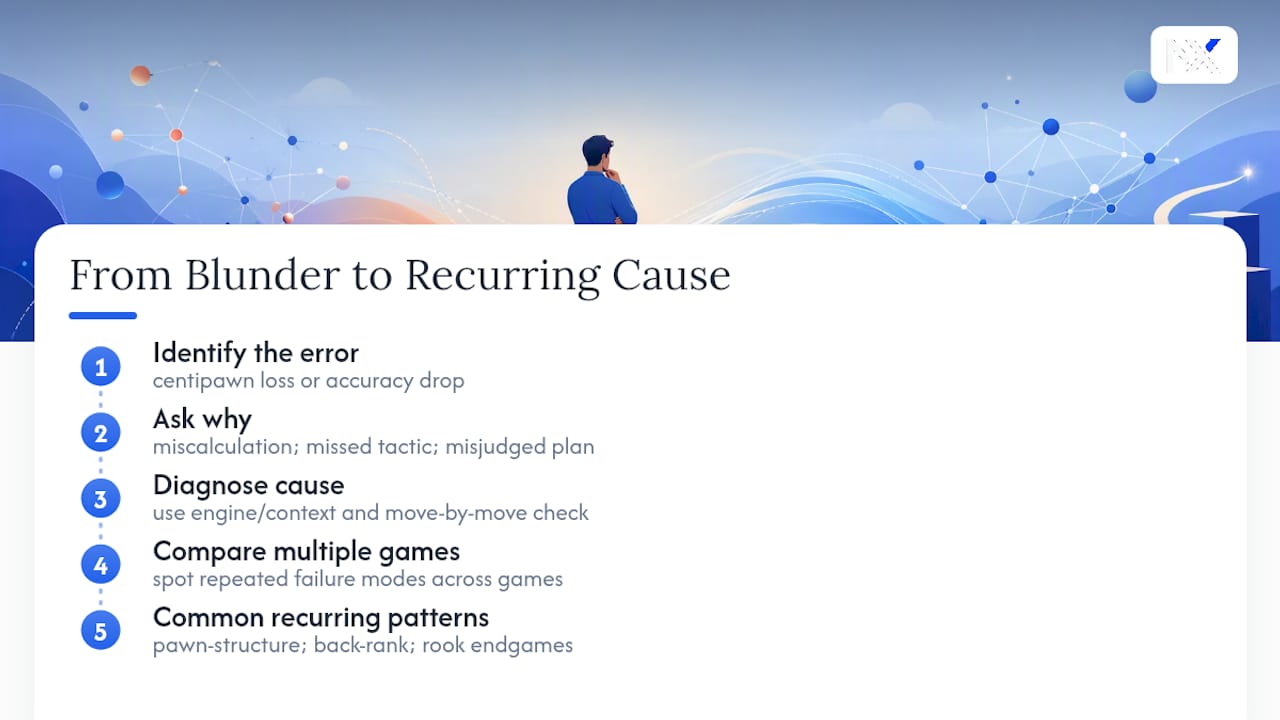
When you spot a blunder, don't just note that it happened. Ask why: did you miscalculate a forcing sequence, miss a tactic, or misjudge a plan? Inaccuracies deserve the same question on a smaller scale. The real value shows up when you compare several games and notice the same failure mode: dropping the same pawn structure into trouble, missing back-rank tactics, or misplaying rook endgames repeatedly. That repetition is your actual weakness, not any one move.
From Report to Practice: A Weekly Study Plan
A pile of analyzed games does nothing for your rating sitting in a folder. Converting the report into a repeatable weekly habit is what actually moves the needle.
- Pick one or two recurring weaknesses, not five. If your last three losses all involved missed tactics in sharp middlegames, that's this week's focus. Resist the urge to fix everything the engine flagged at once.
- Drill the specific pattern. If tactics are the problem, run a themed puzzle set targeting that motif (pins, discovered attacks, back-rank issues) rather than random puzzles. If it's an opening line, replay the divergence point against the engine until the correct plan feels automatic.
- Annotate one game per week by hand before checking the engine. Write down what you were thinking at each critical juncture, then compare your reasoning to the engine's line. The gap between your plan and the best plan is often more instructive than the blunder itself.
- Track trends, not single games. A rolling view across ten or twenty games shows whether your accuracy in the opening phase is improving even if any individual game looks messy.
Pro Tip: Set a tiny, measurable goal each week, like "reduce blunders in time pressure from three per game to one." Vague goals like "play better" don't give you anything to check against next week.
How Nexachess Turns These Habits Into One Workflow
Everything above works with a single exported PGN and a free engine, but running it manually across dozens of games gets tedious fast. Nexachess was built to handle that consolidation automatically.
- It imports games directly from Lichess and Chess.com and pulls them into one consolidated view instead of scattered individual reports.
- Analysis runs on Stockfish and breaks performance down by game phase, separating your opening, middlegame, and endgame accuracy instead of giving one blended number.
- The platform surfaces recurring mistakes across your game history, so you see the pattern instead of hunting for it manually.
- It estimates a FIDE-equivalent rating from your online games and tracks weekly trend lines, showing whether your endgame accuracy is actually climbing or just noisy.
Getting started takes three steps: import a game or connect your account, review the phase-by-phase breakdown for the weak spot the report highlights, and act on the drills the pattern suggests. The consolidation is the real time-saver. You're not reassembling ten separate reports by hand to find the theme.
Where Engines Help and Where Human Judgment Still Wins
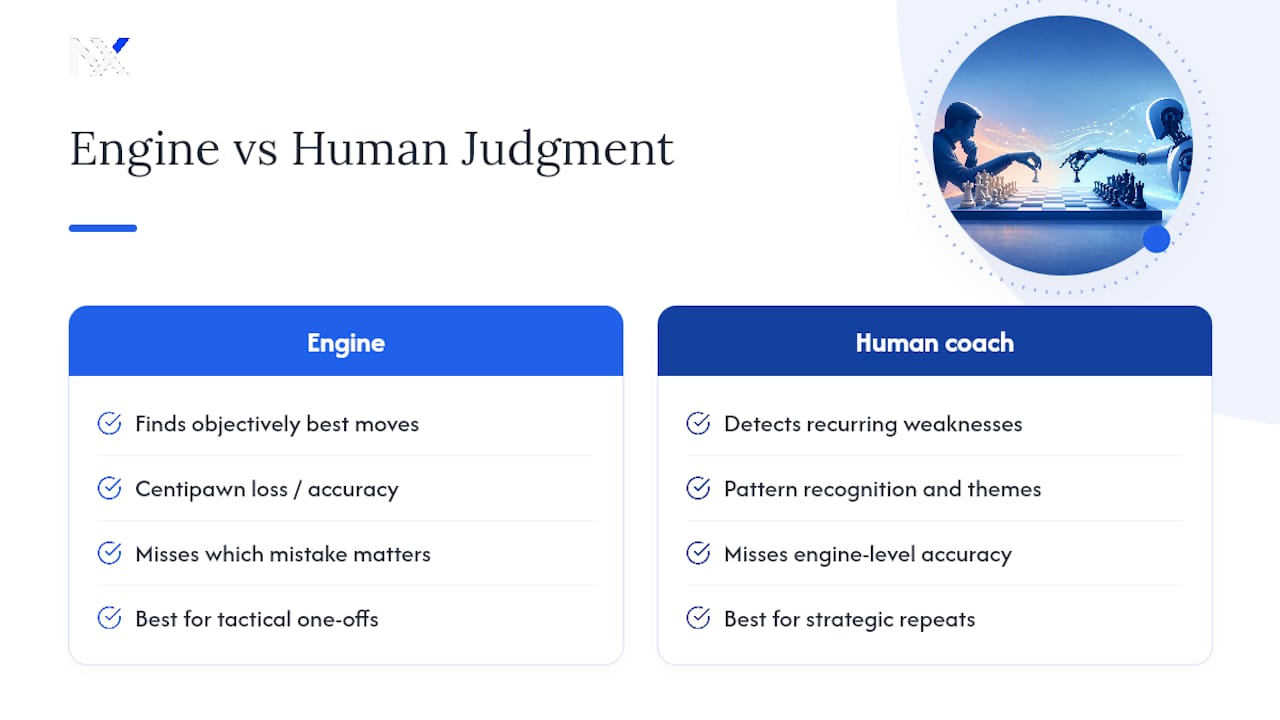
Engines are extraordinarily good at telling you the objectively best move. They're much worse at telling you which mistake matters most for your development as a player. A centipawn loss of 40 on move 22 might be tactically real but strategically irrelevant to your growth, while a smaller, quieter positional drift that repeats across ten games is the thing actually capping your rating.
Chasing every engine suggestion is a trap. Optimizing for accuracy percentage instead of recurring themes wastes study time on one-off moves you'll likely never repeat. The engine can't tell you that you consistently misjudge rook endgames or that your opening choices lead to structures you don't understand. That's pattern recognition, and it's exactly where a human coach or a well-annotated master game earns its place, especially once you've outgrown what raw evaluation numbers can teach you.
— carles
Start With Nexachess: Import Your First Game Today
Your first Nexachess report gives you three things at once: a phase-by-phase breakdown of where points actually leaked, a flagged list of recurring mistakes pulled from your game history, and a trend view showing whether last month's practice is paying off.
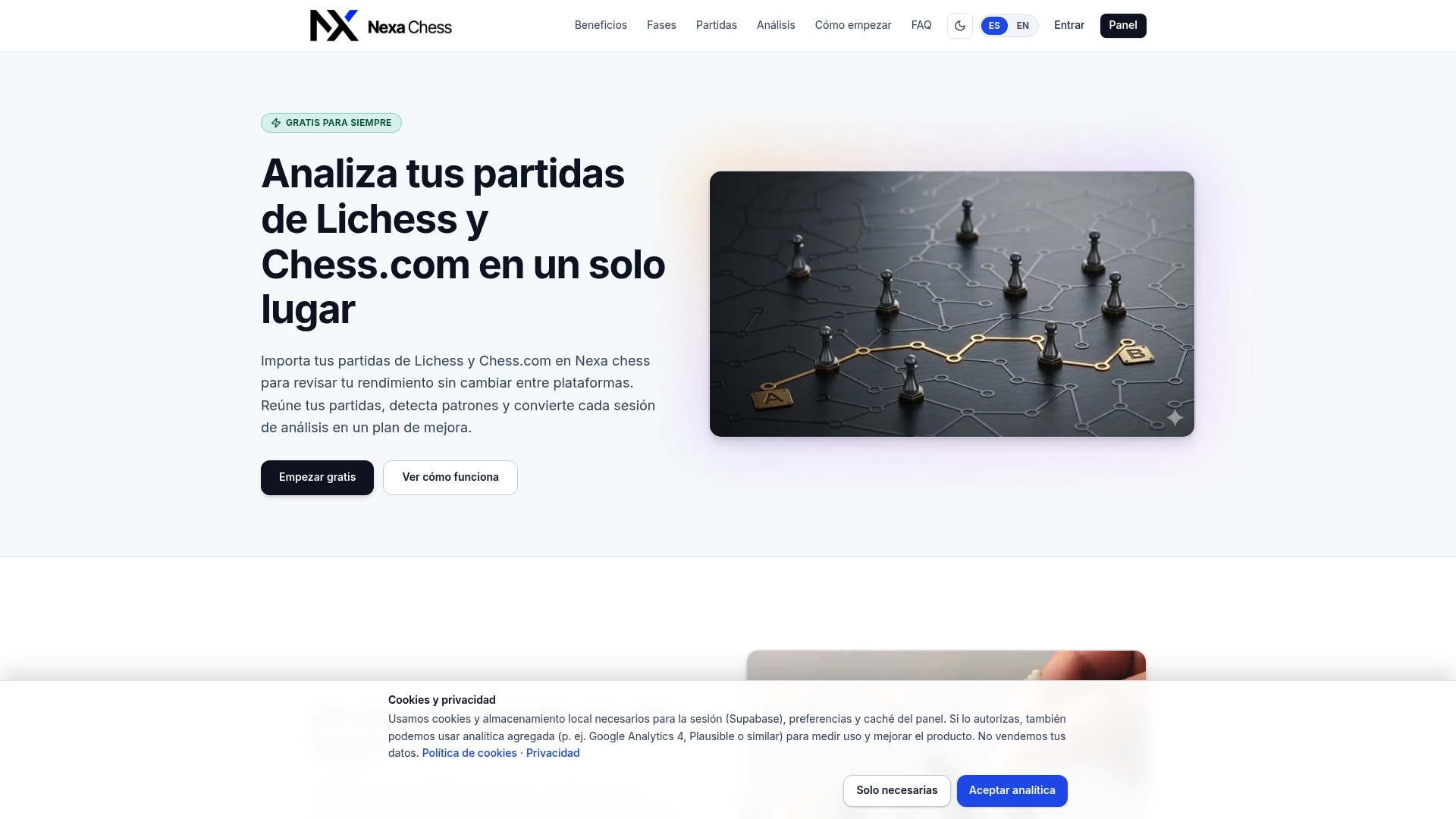
There's no manual PGN wrangling required. Connect your Lichess or Chess.com account, and Nexachess pulls your recent games into one consolidated dashboard instead of a folder of separate reports. If you've been meaning to figure out why your endgame accuracy keeps sliding, or whether that opening line is actually working for you, import your first game on Nexachess and see the phase breakdown for yourself.
Tools Worth Bookmarking for Deeper Verification
Want to check engine behavior directly? The Stockfish repository documents every release and search parameter. For community-built alternatives, WintrChess is an open-source project worth inspecting if you want to see how a free analyzer is built under the hood.
Sources
FAQ
What Is a Good Accuracy Score in a Chess Game Analysis?
High accuracy percentages generally reflect strong, near-optimal play, though the score can look deceptively low or high depending on how sharp or forcing the position was.
Is Free Chess Game Analysis as Good as Paid Tools?
Most free analyzers and paid platforms run the same underlying engine, so the evaluation quality is often comparable; the real difference is in workflow, consolidation, and how the report is presented. Platforms like Nexachess focus on that consolidation layer, importing and organizing your games rather than replacing the engine math itself.
How Many Games Should I Analyze Before I See Patterns?
Analyzing a moderate number of games usually reveals clear recurring themes, since single-game blunders are noisy while patterns across multiple losses point to a genuine skill gap.
Can Nexachess Estimate My Real Chess Rating?
Yes, Nexachess estimates a FIDE-equivalent rating based on your Lichess or Chess.com game history, giving you a reference point beyond your platform-specific rating.
What Should I Do First After Getting an Analysis Report?
Look at the evaluation graph for the steepest drop, identify what caused it, then check whether that same type of mistake shows up in your last several games before deciding what to drill this week.