
Accuracy measures how closely your moves matched engine-preferred moves in the positions that actually appeared on the board, expressed as a percentage built from per-move engine comparisons. The game score you see after a Lichess or Chess.com analysis is an aggregate, not a verdict on your chess IQ. Read it as a diagnostic signal, and remember that a quiet, low-complexity game will always inflate the number compared to a sharp tactical fight.
TL;DR:
- Accuracy scores vary significantly depending on the engine version, settings, and the platform's aggregation method, making cross-platform comparisons unreliable.
- High accuracy in quiet, low-pressure games often reflects ease rather than skill, while complex or sharp positions might produce lower scores despite strong play.
- Tracking accuracy trends within the same platform over multiple games reveals more about your progress than single-game or cross-platform comparisons.
- Context such as game length, opponent strength, and position complexity influences accuracy, so it should be used alongside phase breakdowns and mistake tagging for meaningful analysis.
- Nexa Chess offers phase-based analysis and trend tracking based on your online games, helping turn accuracy percentages into concrete improvement insights without subscription fees.
Table of Contents
- What Chess Accuracy Actually Measures
- Why Your Accuracy Score Changes Depending on Where You Check It
- How to Read an Accuracy Score Without Overreacting to It
- What Accuracy Doesn't Tell You
- A Post-Game Routine That Actually Uses Your Accuracy Data
- How Nexa Chess Turns Your Accuracy Data Into a Study Plan
- Where Chess Accuracy Metrics Actually Came From
- Accuracy vs. Centipawn Loss vs. Evaluation Score: What's the Difference?
- What a Real Accuracy Number Looks Like in Practice
- Does Your Playing Style Change Your Typical Accuracy Score?
- What I'd Tell You If You Asked Me Directly
- Try Nexa Chess for Consolidated, Phase-Based Accuracy Tracking
- Sources
- FAQ
What Chess Accuracy Actually Measures
Understanding what is accuracy in chess starts with the engine underneath it. Every move you make gets compared against what an engine like Stockfish considers best in that exact position, and the gap between your move and the top choice becomes the raw material for the score.
That raw material is a centipawn value, a unit equal to one hundredth of a pawn's worth of advantage. Centipawns are precise but not intuitive: a 40 centipawn swing in an already lost position means almost nothing, while the same swing in a balanced middlegame can flip the outcome entirely. That's the core problem platforms had to solve.
Once every move in the game has a win percentage delta, platforms aggregate all those deltas into one number using statistical methods designed to reduce noise.
Three tools do most of the heavy lifting in that aggregation step:
- Weighted arithmetic mean: gives more influence to moves in volatile, high stakes positions and less to forced or trivial moves, following the same logic used in any weighted arithmetic mean calculation.
- Harmonic mean: pulls the final score down when a handful of ugly moves would otherwise get diluted by a long streak of decent ones, a property inherent to the harmonic mean.
- Generalized mean framing: explains why swapping one averaging method for another produces a visibly different number from the same raw move data, as the math behind generalized means shows.
Why Your Accuracy Score Changes Depending on Where You Check It
Play the same game and run it through two different sites, and you'll often get two different accuracy scores. That's not a bug. It's a byproduct of every platform making its own choices at each step of the pipeline.
- Engine version and settings differ. NNUE-based Stockfish evaluations behave differently than older classical evaluation, and even small version differences shift centipawn output for the same position.
- The centipawn-to-win% conversion isn't standardized. There's no single accepted accuracy formula, and published comparisons show real platforms using different curves and aggregation steps to turn the same centipawn number into a different win percentage, as this breakdown of different ways to calculate accuracy lays out.
- Aggregation tweaks compound the gap. Sliding windows, volatility weighting, and rounding rules all nudge the final number, and these choices are typically built to reduce noise from one-off blunders or long lopsided stretches so the score feels more intuitive to the player looking at it.
- Labeling and move-counting rules vary. Some tools exclude book openings or forced recaptures from the calculation; others include every move played.
The practical takeaway: stop comparing your Lichess accuracy vs Chess.com accuracy as if they're the same currency. Track trends inside one platform instead. A rising or falling line over 20 games on the same site tells you far more than a single cross-platform snapshot.
How to Read an Accuracy Score Without Overreacting to It
A fixed benchmark, like assuming 90% is "good" and 75% is "bad," breaks down fast once you factor in position complexity. A quiet endgame against a weaker opponent who hands you easy decisions will produce a high accuracy score with almost no real skill demonstrated. A wild, sharp game against a strong opponent can produce a mediocre score even when you played near your ceiling.
A few better habits than chasing a threshold:
- Compare your accuracy across a run of games on the same platform, not a single result.
- Check the phase breakdown, opening, middlegame, endgame, before drawing conclusions from the overall percentage.
- Scan for one or two decisive blunders that dragged the whole game score down, rather than assuming every move was mediocre.
- Recognize that long, hopeless resistance in a lost position can inflate accuracy because there's no way to make things worse.
- Recognize that creative, practical, slightly imprecise play against a real opponent can produce a lower number while still being the correct competitive choice.
What Accuracy Doesn't Tell You
An accuracy score chess players lean on can't measure difficulty. It treats a move you calculated for ten seconds the same as a move you found after wrestling with a five-move combination for ten minutes. Both count as a match if they land on the engine's top choice.
That flattening effect creates real distortions. A single blunder in an otherwise clean game can crater your score even though 39 other moves were sound. On the flip side, a long stretch of dominant, low-pressure play against a much weaker opponent can pump your percentage up without teaching you anything about your actual decision-making under pressure.
Coaches tend to treat the headline number as a starting point, not a conclusion. What matters more is the pattern underneath it: are your errors clustering in a specific opening, in time pressure, in transitions between phases?
Pro Tip: Instead of tracking your accuracy percentage game by game, tag your mistakes by category, opening error, missed tactic, endgame technique, over a batch of 15 to 20 games. The recurring tag tells you what to study. The single-game percentage rarely does.
A Post-Game Routine That Actually Uses Your Accuracy Data
Chess performance metrics only pay off when you turn them into a repeatable process. Here's a routine that takes ten minutes and beats staring at a percentage.
- Scan for the biggest win% swings first. These are your real blunders, not the small dips.
- Tag each swing by category. Was it a tactical miss, a positional misjudgment, or a time-pressure decision?
- Check accuracy by phase, not just overall. A game that's 95% accurate in the opening and 60% in the endgame tells you exactly where to study next.
- Log recurring tags across your last 10 to 15 games. One bad endgame is a fluke. Five bad endgames is a study plan.
- Pick one drill per week from your most frequent tag. Rotating between three problems dilutes progress; one focused fix compounds it.
Pro Tip: If your opening-phase accuracy is consistently strong but your middlegame collapses, don't buy another opening course. You already know the theory. You need calculation drills for the moment the book line runs out.
How Nexa Chess Turns Your Accuracy Data Into a Study Plan
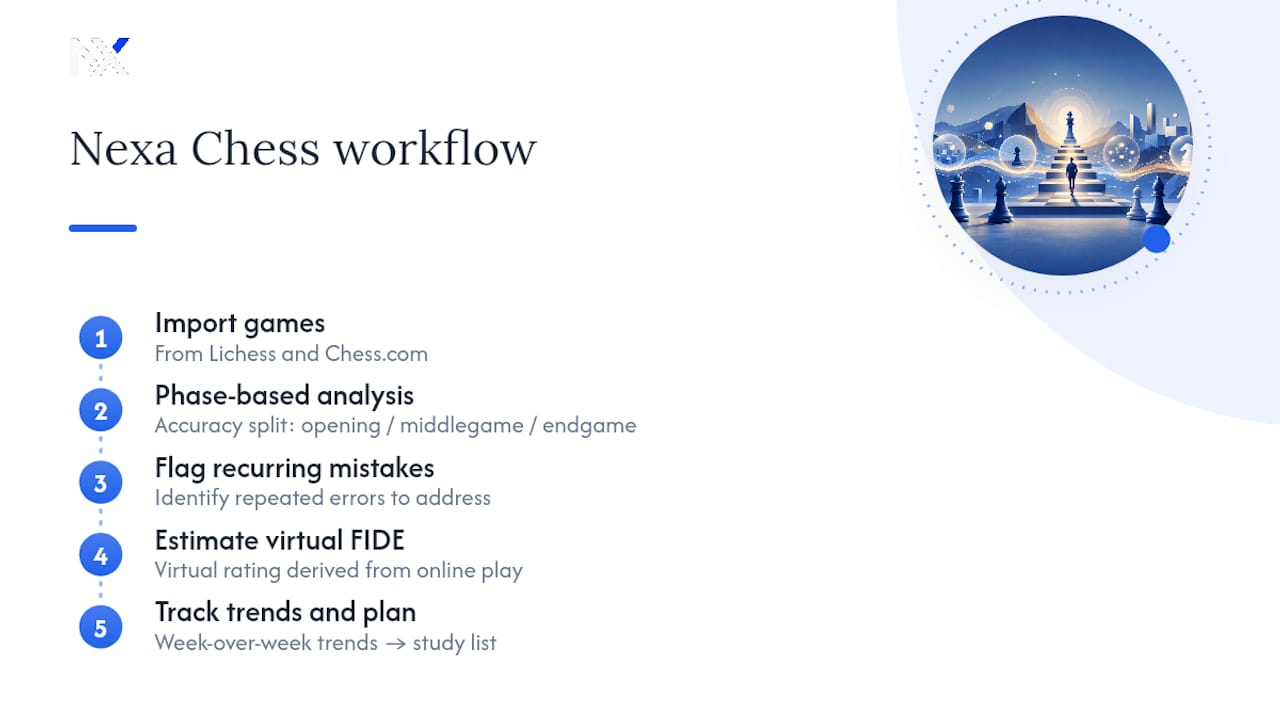
Nexachess imports your games straight from Lichess and Chess.com, then runs phase-based analysis that maps engine accuracy onto the opening, middlegame, and endgame separately. It flags recurring mistakes, estimates a virtual FIDE rating from your online play, and tracks trends week over week, turning one abstract percentage into a concrete list of what to fix next.
Where Chess Accuracy Metrics Actually Came From
Chess players have judged game quality by centipawn loss for years, long before any platform slapped a single percentage on the scoreboard. Early engine analysis simply reported how many centipawns you lost per move, averaged across the game. That worked for engines and serious analysts, but it meant almost nothing to a casual player trying to gauge, "was that a good game?"
The shift toward a percentage-based accuracy score came from a need to translate raw engine output into something intuitive. Centipawn loss punishes mistakes in already-decided positions the same way it punishes mistakes in balanced ones, which distorts the picture for anyone not fluent in engine evaluation. Converting centipawns into a win percentage change fixed that, because it scales the penalty to how much a move actually mattered.
Online platforms popularized this shift as engine analysis became a standard post-game feature rather than a specialist tool. Once free engine access became universal through projects like Stockfish, the bottleneck moved from "can we evaluate the game" to "how do we present that evaluation in a way a 1200-rated player understands at a glance." The accuracy percentage was the answer, even though, as implementation details in open repositories like Lichess's own evaluation code show, the exact conversion math is still an evolving, platform-specific choice rather than a settled standard.
Accuracy vs. Centipawn Loss vs. Evaluation Score: What's the Difference?
These three terms get used almost interchangeably by players, and that's a mistake. Each measures something different, and mixing them up leads to bad conclusions about your own play.
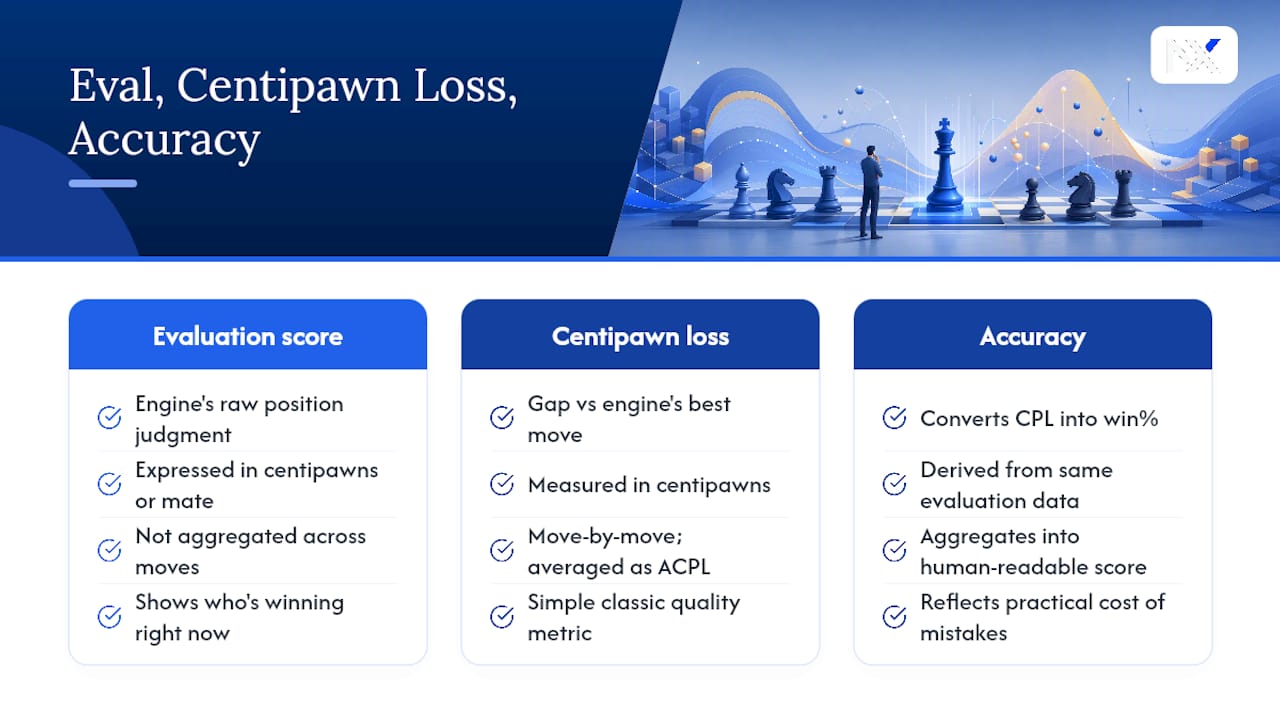
Evaluation score is the engine's raw judgment of a position at a given moment, typically expressed in centipawns or as a mate count. It tells you who's winning and by how much right now. It says nothing about how you got there.
Centipawn loss measures the gap between the move you played and the engine's best move, in that same centipawn unit, move by move. Average centipawn loss (ACPL) has been the classic quality metric for years because it's simple to calculate directly from evaluation scores. Its weakness is the one already covered: it treats a 100 centipawn slip in a dead-lost position the same as a 100 centipawn slip in a razor-close middlegame, even though only one of those actually changes the outcome.
Accuracy tries to fix that weakness by converting centipawn loss into win percentage terms before aggregating. It's a derived, human-readable layer built on top of the same raw evaluation data that produces centipawn loss. Think of evaluation score as the raw material, centipawn loss as the first-pass quality measure, and accuracy as the refined version designed to match how much a mistake actually cost you in practical terms.
None of the three replaces the others. A strong player reviewing a game will still glance at the raw evaluation swings to understand what happened, use centipawn loss to spot the size of a mistake, and use accuracy to get a quick, comparable sense of overall game quality.
What a Real Accuracy Number Looks Like in Practice
Two games can carry wildly different stories behind the same headline number, and that's the clearest way to see why context matters more than the percentage itself.
Picture a 45-move game where one side blunders a piece on move 12, then fights on in a lost position for 30 more moves without further errors. The engine will mark most of those 30 moves as accurate, because there's no way to make an already-lost position much worse. The overall accuracy score might land in the high 80s, but it's measuring resilience in a dead position, not strong decision-making.
Now picture a sharp 25-move game where both sides navigate genuine complications, sacrifice material for initiative, and one side finds three difficult defensive resources under pressure before eventually drawing. That player's accuracy might read in the mid 70s despite playing at a much higher level than the blunder-then-survive example above.
A third scenario matters just as much: a quick 20-move win against a much weaker opponent who hands over material early. High accuracy here mostly reflects an easy opponent, not improved skill. This is exactly why comparing accuracy across games without checking context, game length, opponent strength, position complexity, produces misleading conclusions about actual progress.
Does Your Playing Style Change Your Typical Accuracy Score?
Yes, and this is one of the more overlooked pieces of accuracy in chess. Cautious, positional players who avoid complications tend to post higher accuracy scores on average, simply because fewer of their positions carry sharp, high-volatility moments where a slight misstep tanks the win percentage.
Aggressive, tactical players who regularly sacrifice material or steer into complications will often see more volatile accuracy scores game to game, even when they're objectively strong players. Sharp positions carry bigger win% swings per inaccuracy, so the same size of error costs more in the aggregation.
Rating level shifts the picture too. Beginner and intermediate players tend to see accuracy fluctuate heavily between games because their error rate is higher and less consistent. Stronger players still see fluctuation, but it clusters more tightly, and their errors tend to show up in narrower, more identifiable moments, a missed tactic in a sharp middlegame rather than a basic piece drop. That's part of why the same 80% accuracy score can represent a strong performance for one player and a mediocre one for another. It depends heavily on what kind of positions that player tends to create on the board.
What I'd Tell You If You Asked Me Directly
Treat accuracy as a smoke detector, not a report card: useful for flagging where to look, useless for judging how well you actually played. Use it for self-study when your errors cluster in an identifiable pattern; bring in a coach when you can't tell why the same mistake keeps recurring.
Try Nexa Chess for Consolidated, Phase-Based Accuracy Tracking
Most players check their accuracy score once per game and forget it. Nexachess is built around the opposite habit: pulling every game you've played on Lichess and Chess.com into one dashboard so a single percentage turns into a trend line you can actually act on.

The platform runs Stockfish-based analysis across your opening, middlegame, and endgame separately, flags the mistakes you keep repeating, and estimates a virtual FIDE rating from your online games, all without a subscription or credit card, since the plan is free forever. That phase breakdown is what turns "my accuracy was 78% last week" into "my endgame technique is costing me two points a month." If you want to see where your own game breaks down, import your games and start tracking your phase accuracy.
Sources
- Stockfish
- Comparing Different Ways to Calculate Accuracy
- Weighted arithmetic mean — Wikipedia
- Harmonic mean — Wikipedia
FAQ
Is 92% Accuracy in Chess Good?
An accuracy score in the low 90s is strong in most contexts, especially in longer games with real complexity, but it's not an automatic sign of a flawless performance. Check the phase breakdown and game length before treating it as proof of a great game, since a short, low-complexity win can also produce a similar number.
Is a 300 Chess Score Bad?
If "300" refers to a rating rather than an accuracy percentage, that's a beginner-level rating on most platforms, reflecting very early familiarity with the rules and basic tactics rather than a poor showing. It's not a meaningful accuracy figure at all, since accuracy is reported as a percentage, not a numeric rating.
How Good Is 78% Accuracy in Chess?
78% is a reasonable, middle-of-the-pack score for a game with real tactical complexity, and it often reflects solid play with a couple of inaccuracies rather than a weak performance.
Is 80% Accuracy in Chess Good?
It's not a fixed pass or fail line, and a single blunder that drags an otherwise clean game down to 80% tells a very different story than a game full of small, scattered imprecisions.
Does Nexa Chess Calculate Its Own Accuracy Score?
Nexachess focuses on importing your existing Lichess and Chess.com games and running Stockfish based phase analysis on top of them, turning your accuracy trends into concrete opening, middlegame, and endgame insights. It's free to use, with no published pricing tiers listed on the site as of now.