

A centipawn is one hundredth of a pawn's value, the unit engines used to score positions. Average centipawn loss, or ACPL, tracks how far your moves fall short of the engine's best choice, move after move, then averages the damage. Lower is better: elite classical games often land in the single digits to low teens, strong club players hover in the 25 to 50 range, and blitz games routinely climb past 50 no matter your rating.
TL;DR:
- ACPL values are heavily influenced by analysis depth, engine settings, and rounding rules, causing reported figures to vary by 5 to 10 points even for identical games.
- For classical games, elite grandmasters typically maintain ACPL between 10 and 25, while club players often range from 25 to 60, depending on opponent strength and time control.
- ACPL should be interpreted in context; small losses in balanced positions may be inconsequential, while large swings in tactical or endgame phases signify genuine mistakes.
- Tracking ACPL trends over time and analyzing phase-specific spikes provides more actionable insights than reviewing a single aggregate number.
- Combining ACPL with other metrics like blunder counts and accuracy percentage offers a clearer picture of overall playing strength and areas for targeted improvement.
Table of Contents
- What Is Centipawn Loss in Chess, and How Is It Calculated?
- ACPL Benchmarks by Rating and Time Control
- Where ACPL Falls Short as a Performance Metric
- Turning ACPL Into a Training Plan
- Reading ACPL Charts and Distributions
- How an advanced chess analysis platform can turn ACPL into phase-specific insight
- What a Given Centipawn Loss Actually Means at the Board
- How ACPL Stacks Up Against Other Chess Metrics
- Common Mistakes That Show Up as High Centipawn Loss
- How Centipawn Loss Shifts From Opening to Endgame
- Balance the Numbers With Your Own Judgment
- Sources
- FAQ
What Is Centipawn Loss in Chess, and How Is It Calculated?
Engines score every position in centipawns, with 100 centipawns equal to roughly one pawn of advantage. The sign flips depending on whose turn it is: a positive number favors White, a negative number favors Black, and the engine converts this so each player's loss is always a positive value.
The per-move calculation is simple in concept. The engine evaluates the position before your move, then evaluates it after your move, and the drop between the engine's best continuation and your actual choice becomes that move's centipawn loss. String every move together, average them, and you get ACPL, a single number representing the average centipawn difference between your move and the engine's top pick across the whole game.
Two games with identical final scores can produce very different ACPL readings depending on how the analysis was run. Some sources of variation matter more than people realize:
- Book and forced moves: some tools exclude the opening's memorized theory or moves where only one legal option exists, which lowers the reported average.
- Engine depth: a shallow search sees less than a deep one, so the same game analyzed at depth 12 versus depth 20 can yield different numbers.
- Multi-PV settings: engines checking multiple candidate lines sometimes flag near-equal alternatives that a single-line search would have missed, shifting the loss slightly.
- Rounding and weighting rules: some platforms cap the maximum penalty per move (so one 900-centipawn blunder does not dominate the whole average), while others do not.
That last point is worth sitting with. Two identical games run through different chess engines or different analysis tools can report ACPL figures that diverge by 5 or 10 points purely from methodology, not from how you actually played.
ACPL Benchmarks by Rating and Time Control
Numbers mean nothing without context, so here is where players actually land. In classical games with long thinking time, strong grandmasters often post ACPL in the 10 to 25 range, while club-level players in the same time control commonly see averages between 25 and 60. Elite world championship level play can dip into very low single-digit ACPL values for entire games, a level of precision that reflects both preparation and the luxury of time.
By the numbers: Classical games among top grandmasters frequently show ACPL in the low tens (roughly 10 to 25), while club players in the same format typically register 25 to 60, depending on time control and opponent strength.
Time control changes everything. A 3 minute bullet game gives you seconds per move, and even titled players see their ACPL spike well above their classical numbers simply because there is no time to calculate. Rapid games sit somewhere in between: tighter than blitz, looser than classical. This is also why rating and ACPL correlate but never perfectly. A 1400 player having a great day in a slow game can outscore their own blitz average by 30 points or more, and the reverse happens constantly too.
Where ACPL Falls Short as a Performance Metric
ACPL is useful, but treating it as gospel leads to bad conclusions. The number reflects engine agreement, not chess understanding, and it carries real blind spots.
- Depth dependency: a game analyzed at low engine depth may miss a tactic entirely, scoring a blunder as a minor slip because the engine itself didn't see the punishment.
- Forced and technical moves: converting a completely won endgame often produces small, harmless centipawn losses on nearly every move, since there's rarely a single "best" square when you're up a rook and two pawns. That inflates ACPL for a game you were never in danger of losing.
- Winning-move inflation: the flip side, playing a "good enough" move in a totally lost position, can register as a huge loss even though no move would have saved the game.
- Not a cheating detector on its own: unusually low ACPL sparks suspicion in some communities, but a low number alone proves nothing. Fair-play investigations use move-matching, timing patterns, and statistical modeling well beyond a single ACPL figure.
Single-game ACPL is also just noisy. One tactical miracle or one hallucinated blunder in an otherwise clean game can swing the average, so reliable interpretation depends on aggregated samples, not one data point.
Turning ACPL Into a Training Plan
A raw ACPL number tells you almost nothing useful until you break it apart. The real value shows up when you filter and compare properly, then hunt for patterns instead of staring at one aggregate figure.
- Filter by time control first. Comparing your blitz ACPL to your classical ACPL is comparing two different skills. ACPL is only meaningful when you compare like-for-like samples: same time control, similar opening, similar opponent strength.
- Locate the spikes, not just the average. Pull up the per-move evaluation and find where the biggest jumps happen. A single move that loses 300 centipawns in an otherwise tidy game tells a completely different story than ten moves each losing 30.
- Map spikes to game phase. Opening spikes usually mean you left prep too early or misremembered a line. Middlegame spikes point to tactical oversights or plans that don't hold up to calculation. Endgame spikes often mean technique gaps: wrong king placement, missed opposition, or rushed conversions.
- Match the fix to the pattern. Tactical spikes call for daily puzzle work. Opening spikes call for reviewing your actual repertoire against a database, not memorizing more lines blindly. Endgame spikes call for studying specific structures like rook endings or opposite-colored bishops rather than generic "endgame practice."
- Watch your clock, not just your moves. A rough rule of thumb: don't burn more than 20% of your remaining time on any single non-critical decision. Time trouble is one of the most common hidden causes behind late-game ACPL spikes.
Pro Tip: Before you touch an opening book, pull the last ten games where your ACPL spiked in the first 15 moves and check whether it's the same three lines causing trouble. Fixing one repeated leak often does more for your rating than a week of random study.
Reading ACPL Charts and Distributions
A single ACPL number flattens an entire game into one figure, which is exactly why charts matter more than most players assume. Two visualization types do most of the work.
- Per-move line charts plot centipawn loss move by move, making it easy to spot exactly where a game went sideways.
- Histograms group your losses into buckets across many games, revealing whether your errors cluster in a tight, controlled range or spread out unpredictably.
A tight cluster of small losses around 10 to 20 centipawns suggests steady, if imperfect, play. A histogram with a long tail, mostly clean moves plus a handful of 200-plus centipawn disasters, suggests the opposite problem: you're not making small errors, you're making occasional catastrophic ones. Public resources like the Lichess database give players and researchers enough raw game data to build these distributions themselves. Either way, the aggregate average alone hides which phase is actually bleeding points, which is why phase-by-phase breakdowns matter more than the headline number.
How an advanced chess analysis platform can turn ACPL into phase-specific insight
Some chess analysis platforms import games directly from Lichess and Chess.com, then run them through Stockfish-based evaluation to simplify the user's workflow.
- Games can be sorted and analyzed with phase-specific breakdowns, splitting ACPL into opening, middlegame, and endgame segments instead of one flat average.
- Recurring mistakes can be flagged across game history, making repeated tactical leaks or specific opening lines that cost points visible rather than buried in individual game reports.
- Some platforms generate a virtual FIDE-style rating estimate from online games, providing a reference point beyond Lichess or Chess.com ratings alone.
- Weekly trend tracking can show whether ACPL is improving over time, rather than judging progress from one session alone.
Every feature above runs on the free tier, since Nexachess is currently free to use with no payment required to get started.
What a Given Centipawn Loss Actually Means at the Board
A 15 centipawn loss on one move rarely matters. Engines routinely rate several candidate moves within 10 to 20 centipawns of each other in balanced positions, so a "loss" that small is often just a stylistic choice between two reasonable plans. Context is everything here: the same 15 point loss in a sharp tactical position where only one move holds the balance is a completely different kind of mistake than in a quiet position with five roughly equal options.
The scale shifts as the number grows. A loss between 50 and 100 centipawns usually signals a real inaccuracy, missing a stronger plan or allowing your opponent slightly better chances without immediately losing material or position. Cross into 100 to 300 and you're typically looking at a genuine mistake: dropping a pawn, weakening your king unnecessarily, or missing a tactical shot your opponent then finds. Above 300 centipawns, you're in blunder territory, the kind of move that hands away a piece, a forced mating sequence, or a completely lost endgame.
Game phase changes how much a given loss should worry you. A 100 centipawn loss in a wild opening gambit might just mean you took a calculated risk that didn't fully pan out. The same 100 point loss in a simplified rook endgame, where precision is everything and there's nowhere left to create complications, is a much bigger problem. Reading centipawn loss well means asking not just "how big was the drop" but "how many reasonable alternatives existed, and how sharp was the position when I dropped it."
How ACPL Stacks Up Against Other Chess Metrics
ACPL measures precision, but precision is not the only thing that determines results, which is why comparing it against other performance metrics matters. Win rate tells you outcomes, not quality. You can win a game with a terrible ACPL because your opponent blundered worse, and you can lose a nearly flawless game to one well-timed tactic.
Accuracy percentage, the format popularized by platforms like Chess.com and Lichess, is essentially ACPL translated into a friendlier scale, typically running from around 0 to 100. The two metrics move together but aren't identical: accuracy percentage weights losses non-linearly, so a handful of small inaccuracies barely dents your score, while one severe blunder tanks it disproportionately.
Blunder count is a coarser but still useful companion metric. Two games can share similar ACPL but tell different stories: one with fifteen tiny 10 point losses spread evenly, another with one 400 point disaster and otherwise perfect moves. Blunder count catches the second pattern instantly; average ACPL can blur it. Rating itself remains the most outcome-focused metric of all, capturing results against specific opposition rather than move quality in isolation. None of these numbers replace the others. Used together, accuracy percentage gives you a quick gut check, blunder count flags the disasters, and ACPL gives you the granular, move-by-move detail needed to actually diagnose what happened.
Common Mistakes That Show Up as High Centipawn Loss
Certain patterns of error appear again and again in game analysis, and each leaves a distinct fingerprint in your centipawn loss data. Recognizing the pattern is often more useful than the raw number itself.
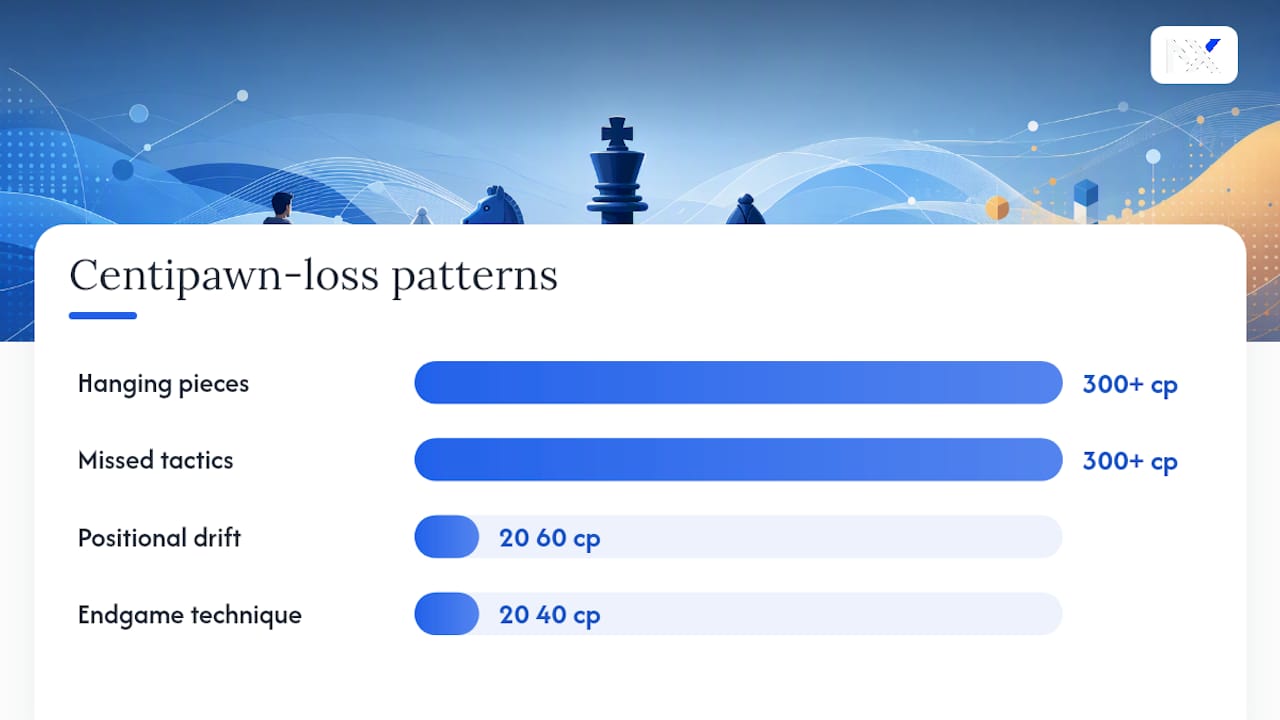
Hanging pieces produces the most obvious spikes: a sudden jump of 300 or more centipawns on a single move, usually with no complicated tactical setup behind it, just a piece left on a square it shouldn't have been on. This is the classic time pressure or inattention error, and it clusters heavily in blitz and bullet games where calculation time simply doesn't exist.
Missed tactics show a slightly different shape. The loss is often just as large, but it follows a position where a combination existed and you played a safe, reasonable looking move instead of finding the shot. These losses tend to cluster in sharp middlegame positions with pieces still on the board.
Positional drift creates a quieter but persistent pattern: a string of moves each losing 20 to 40 centipawns, none individually alarming, but compounding into a genuinely worse position by move 30. This is common among players still developing strategic understanding, since no single move looks wrong, but the cumulative direction is.
Endgame technique errors show up almost exclusively in the final phase: repeated small losses converting a winning position, or a single large loss from misplacing a king or missing a key defensive resource like opposition or zugzwang. These are often the easiest to fix, since they respond well to targeted study of specific endgame structures rather than broad tactical training.
How Centipawn Loss Shifts From Opening to Endgame
Centipawn loss rarely stays flat across a game, and the shape of that curve tells you almost as much as the final average. Openings played from memorized theory typically show very low ACPL, often near zero, since you're recalling known moves rather than calculating. That changes the moment you leave your prepared lines. The first move outside known theory frequently produces a small spike, even among strong players, simply because it's the first genuinely calculated decision of the game.
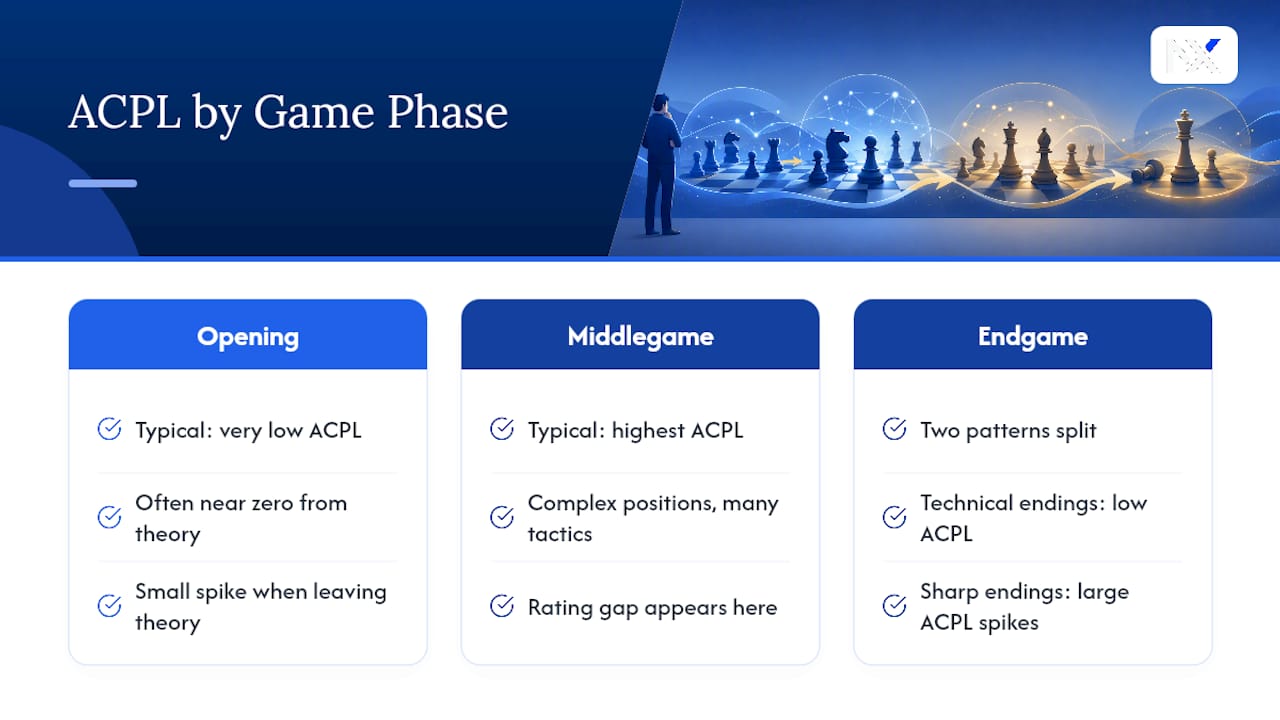
Middlegames tend to carry the highest ACPL of the three phases for most players below master level. This is where positions grow most complex, tactical possibilities multiply, and time pressure starts compounding earlier decisions. It's also where the gap between rating levels shows up most clearly: strong players maintain relatively controlled losses through complications, while weaker players see their averages balloon as calculation demands exceed their ability to keep up.
Endgames split into two very different patterns depending on the position. Technical, simplified endings often show low ACPL because fewer pieces mean fewer candidate moves to evaluate and less room for wild swings. But sharp, unbalanced endgames, opposite-colored bishops, unresolved pawn races, can produce ACPL spikes just as severe as any middlegame blunder, especially under time pressure with the clock running low. Tracking your ACPL phase by phase over many games, rather than as one blended number, is usually the fastest way to find out which stage of the game is actually holding your rating back.
Balance the Numbers With Your Own Judgment
ACPL works best as a compass, not a verdict. It points you toward where to look, not what to conclude, and treating a single game's number as a final judgment on your play misses the point entirely. A 45 ACPL game where you sacrificed material for an attack that ultimately failed is not the same failure as a 45 ACPL game where you just made scattered, unforced errors.
Track the trend line across weeks and months instead of fixating on any one result. A game where you blundered a piece in an equal position tells you less than a month of games showing your middlegame ACPL slowly dropping while your endgame numbers stay stubbornly high. That pattern is a real training signal.
Pair the metric with your own annotation. Go back through the moves the engine flagged and ask why you chose what you chose. The number tells you something went wrong; only you can figure out whether it was a calculation gap, a time problem, or a plan that made sense to you and still didn't work.
— carles
Sources
The claims and benchmarks throughout this piece draw from a handful of primary references worth bookmarking if you want to dig further into the mechanics of centipawn evaluation.
FAQ
Is an Average Centipawn Loss Good in Chess?
It depends entirely on time control and level, but generally an ACPL under 25 in classical chess is considered strong club-level or better play, while figures in the 10 to 25 range often belong to grandmaster-level games. Anything above 50 in a slow time control usually points to real room for improvement, though the same number in blitz is far more normal.
What Is the 20-40-40 Rule in Chess?
This is a rough study allocation heuristic some coaches suggest, splitting practice time roughly across openings, middlegames, and endgames, though the exact split varies by source and isn't a fixed standard. It's better understood as a reminder not to over-invest in opening memorization at the expense of tactical and endgame skill, rather than a precise formula.
Is 88% Accuracy in Chess Good?
The exact ACPL equivalent varies slightly depending on the platform's specific accuracy formula.
Is 0 Centipawn Loss Possible?
A perfect 0 ACPL across a full game is exceedingly rare and essentially never happens in practical play, since it would require matching the engine's top choice on every single move. Short stretches of a game, particularly forced sequences or well-known theoretical lines, can register 0 loss, but sustaining it across 30 or more moves against a competent opponent is not realistic.